


Strana armonia d´amore, Les Cris de Paris and Geoffroy Jourdain

Order tickets
August 2026
Mo
Tu
We
Th
Fr
Sa
Su


About the series
Portrait FRANCESCA VERUNELLI


For her exploration of sound, Francesca Verunelli (*1979), who inaugurates a new series of contemporary composer portraits at the Salzburg Festival, has been awarded major prizes, including the Silver Lion of the Biennale di Venezia Musica 2010 and the Composition Prize of the Ernst von Siemens Music Foundation in 2020. After studying in Florence and Rome as well as at IRCAM in Paris, residencies took her to Rome, Madrid and Marseille. Her intensive artistic research into the interplay between contemporary compositional practice, experimental performance techniques and modern instrument building led to a growing philosophical and theoretical interest, culminating in a doctorate at the Université Paris Sciences et Lettres. She now teaches at the Lucerne University of Applied Sciences and Arts.


Francesca Verunelli has received numerous composition commissions, including from the SWR Symphony Orchestra, Klangforum Wien and the Orchestre Philharmonique de Radio France. Her recent composition La nuda voce was premiered in two parts in 2025 at the Donaueschinger Musiktage and Wien Modern. In several works, she explores the human voice as the most primordial musical instrument, its relationship to the body as a resonating medium, and the presence of song in the absence of the voice. These include the ensemble piece Five Songs (Kafkas Sirens) (2018) and Songs and Voices (2023). In VicentinoOo (2024), Verunelli, for whom our familiar equal temperament has always been somewhat suspect, experiments with microtonality inspired by Renaissance models. In her compositions, the exploration of the temporal duration of sound and the artistic organisation of this temporality play a central role. Composing, Verunelli says, means writing time. Music is the writing of time.

Program and cast

Strana armonia d’amore — Les Cris de Paris · Jourdain | Portrait FRANCESCA VERUNELLI | CONCERT


Les Cris de Paris 

Geoffroy Jourdain - Conductor


Programme

Giovanni Maria Trabaci

Toccata di durezze e ligature


Sigismondo d’India

Strana armonia d’amore … In ciò sol differenti


Hettorre Della Marra

Misero che farò


Michelangelo Rossi

Per non mi dir ch’io moia


Scipione Lacorcia

Ahi, tu piangi, mia vita! … Mirami il volto pur


Carlo Gesualdo

Io pur respiro


Cipriano de Rore

Calami sonum ferentes (instrumental version)


Francesca Verunelli

VicentinoOo I


Nicola Vicentino

Musica prisca caput


Francesca Verunelli

VicentinoOo II


Nicola Vicentino

Madonna, il poco dolce


Francesca Verunelli

VicentinoOo III


Cipriano de Rore

Calami sonum ferentes


Francesca Verunelli

VicentinoOo IV


Carlo Gesualdo

S’io non miro non moro


Francesca Verunelli

VicentinoOo V


Pomponio Nenna

La mia doglia s’avanza (instrumental version)

Ecco, o mia dolce pena


Luzzasco Luzzaschi

Quivi sospiri


Michelangelo Rossi

O miseria d’amante


Carlo Gesualdo

Moro, lasso, al mio duolo


Michelangelo Rossi

Moribondo mio pianto

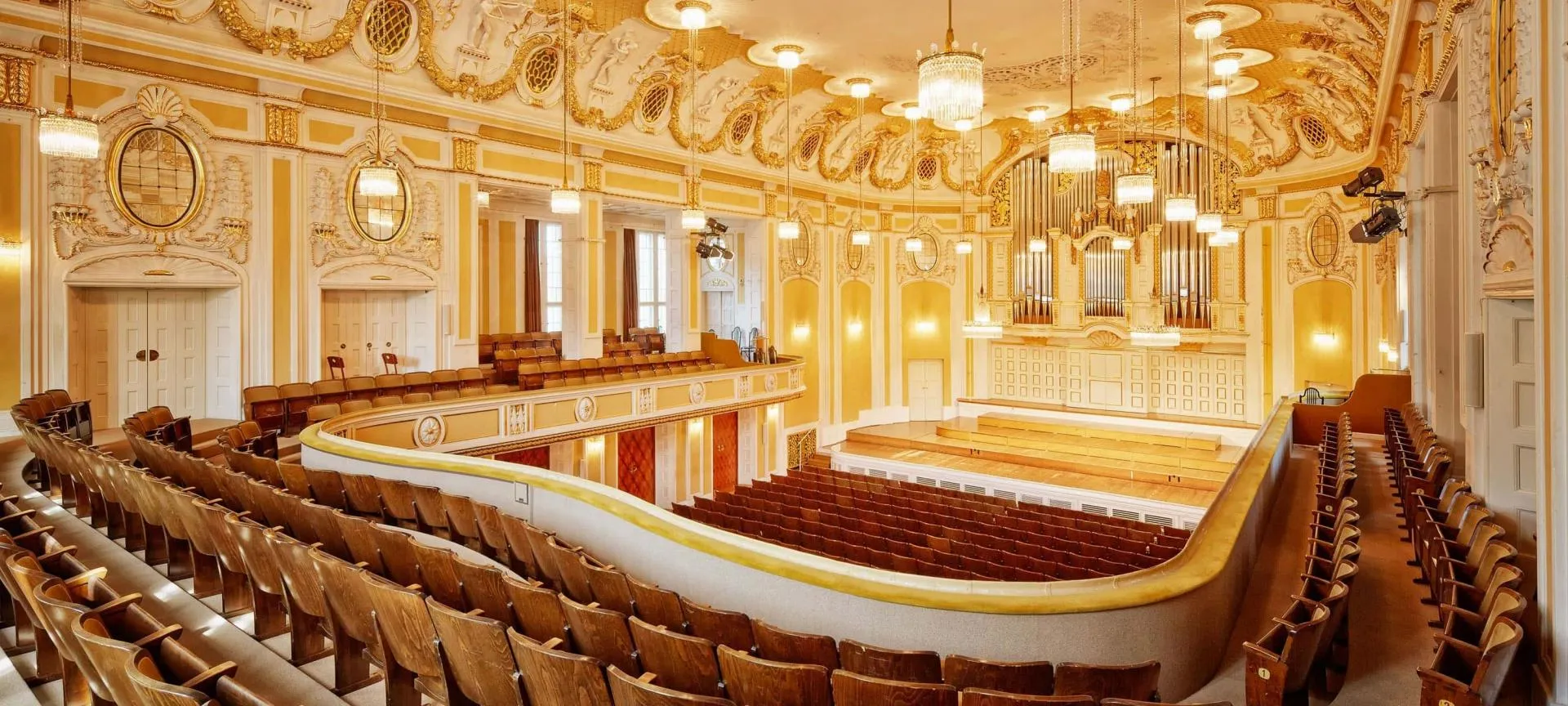
Stiftung Mozarteum

In 1856, the 100th anniversary of Mozart’s birth, an association was founded with the aim of setting up a music school, with a library, archives and concert hall, devoted to Mozart. Various buildings in the inner city area of Salzburg were considered and eventually it was decided to buy the villa of the former interior minister, Josef von Lasser, in the Schwarzstrasse. Conversion work took place from 1910 to 1914 according to plans drawn up by Richard Berndl. The overriding style is late historicism characteristic of Munich, and elegant details were combined with elements of the local Baroque tradition, art nouveau and patriotic building art. In 1917 the board of governors of the International Mozarteum Foundation elected Bernhard Paumgartner unanimously as director of what was at that time a conservatory. This later became an academy and then the Mozarteum Academy of Music and Dramatic Art, and in the meantime it has achieved university status. During the period when Paumgartner was director, this educational institute experienced a great boom: in particular several music-theatre productions took place in connection with the “Mozarteum Opera Series” and it was thanks to his initiative that these performances took place in the Salzburg City Theatre (now the Landestheater).


Financial problems of the International Mozarteum Foundation were offset by nationalising the teaching part of the foundation’s work in 1922 with the result that nowadays two completely separate corporate bodies exist. The Mozarteum University has in the meantime moved most of its departments into its own building on the Mirabellplatz.


The International Mozarteum Foundation has cooperated closely with the Salzburg Festival ever since 1921: the Great Hall of the Mozarteum is one of the main venues of the concert series especially because it is excellent for the performance of chamber music. The Mozart Matinees, morning concerts given at the weekends during the Salzburg Festival, were introduced by Bernhard Paumgartner and have in the meantime assumed legendary status. In 1930 the first courses for conducting and musical instruments were held and this initiative later became the International Summer Academy of the Mozarteum. Every year renowned lecturers come together with enthusiastic music students from all over the world to enter a lively artistic dialogue.


Related events