Spartacus – László Seregi - Aram Ilyich Khachaturian
Neoclassical | Dance drama
Running time: 2 hours 45 minutes including two intervals
Set in the Roman Empire around 74 BC, Spartacus was László Seregi's first true full-length ballet, which at one stroke became a milestone in Hungarian dance life. Since 1968, one generation after another has enjoyed the historically themed choreography, which treats the story of the ancient slave revolt in such a way that its true message is not the rebellion itself, but rather human emotions and choices under pressure. “The subject will remain an eternal one for as long as people are being tormented, killed and treated unjustly, and for as long as there are people who wish to break free.” (László Seregi)
Parental guidance: The performance is not recommended for children under 12 years of age.
Synopsis
Act I
Scene 1
Rome. The Appian Way is lined with crosses bearing crucified slaves, with the dying Spartacus among them. Soldiers accompany the triumphant commander Crassus, suppressor of the slave revolt, who now watches his abased and defeated opponent with anger. Keeping vigil beneath Spartacus's cross is Flavia, the dying man's wife. The woman tries to beg for her husband's life, but Crassus pays her no heed. The visions Spartacus experiences before his death come to life on the stage, with the events of the uprising playing out concisely before his eyes.
Scene 2
Crassus and his noble friends decide to go to Capua, to the gladiatorial school.
Scene 3
The gladiatorial school in Capua. The slaves are performing their usual exercises. Batiatus, the owner of the school, picks out Spartacus and, after a short fight, lays him down. The female slaves offer water to the exhausted warriors. They are accompanied by Flavia, Spartacus's wife, who draws Batiatus's eye. Trumpets signal the arrival of guests: Crassus is coming with his friends Canus, Claudia and Julia. From the line of slaves that has assembled, Crassus selects four. The Thracian Crixus will fight the Judean Gad, while the African will do battle with Spartacus in life-or-death combat. When her husband is chosen, Flavia rushes to join the gladiators and then falls to the ground unconscious.
Scene 4
The four gladiators are locked in a shared cell for the night, but none of them find it easy to sleep. Spartacus remains awake the longest. Flavia sneaks into the cell to bid farewell to her husband. The sleepers awaken and all say their farewells to the Woman, and to life.
Scene 5
In the first contest, Gad kills Crixus. During the pause between the two fights, a female dancer entertains the guests. Meanwhile, Spartacus is led to the viewing box so that the women can see his muscles from up close. The dancer makes Spartacus think of his love, Flavia. In the second duel, Spartacus, armed with a knife, faces the African, who is equipped with a trident and net. The black man gets the better of him, but in a blinding rage, instead of slaying the gladiator, he turns against the Romans in their box. Although his struggle is a futile one, he manages to wound a number of soldiers before one of the guards brings him down. The African dies in the arms of Spartacus, who thrusts his knife into the ground in impotent fury.
Scene 6
The African's corpse is hung up on the grated wall of the yard as a deterrent to the slaves. Spartacus slips out of his cell that night and swears vengeance before the dead body. After killing an approaching guard, he frees Gad and the other slaves. The rebels slay the guards and break out of the arena.
Act II
Scene 1
Years later, Crassus and his two lady friends seek out the arena in Capua, now in ruins. The commander is tormented by memories. He remembers the gladiators, the dead African, and Spartacus and his wife, Flavia.
Scene 2
Crassus is enjoying himself with guests in his summer palace. Claudia and Julia are joined in dance by the commander Crassus himself, and then the entire company of patricians launch into unbridled revelry. Meanwhile, outside, an army of slaves is gathering with Spartacus at their head. They break into the palace, eject those inside, and then the slaves celebrate their victory. They capture Crassus's friend Canus and force him to fight a Roman soldier. Both men are wounded in the battle, but the slaves spare their lives.
Act III
Scene 1
The Senate in Rome. A passionate debate is taking place when a wounded soldier staggers in from the slaves' camp in Capua and drops dead before the senators' eyes. Crassus places a cover over the dead body and then, raising the soldier's sword up high, declares that with the backing of the senate, he will lead an army against the slaves.
Scene 2
The slave revolt has failed, and the army is forced to flee. At the last campsite, Spartacus and Flavia bid farewell to each other and to life. The Romans surround the camp. Spartacus is captured, but his wife escapes.
Scene 3
In Flavia's imagination, the victors march in triumph.
Scene 4
Back at the spot of the opening scene. Spartacus has expired on the cross, with his wife, Flavia, left alone to mourn him. With the death of Spartacus and his comrades, this woman is the only one left to remember the struggle for freedom.
Cast
Conductor: Thomas Herzog, Gabor Hontvari
Spartacus, leader of the slaves: Louis Scrivener, Iurii Kekalo, Gergő Ármin Balázsi, Luca Massara
Flavia, Spartacus's wife: Maria Yakovleva, Maria Beck, Tatyjana Melnyik, Soobin Lee
Crassus, Roman General: Boris Zhurilov, Vlagyiszlav Melnyik, Mikalai Radziush, Raffaello Barbieri
Featuring the Hungarian National Ballet and the Hungarian State Opera Orchestra.
Choreographer: László Seregi
Set designer: Gábor Forray
Costume designer: Tivadar Márk
Assistant choreographer: Ildikó Kaszás
Company répétiteur: Stanislav Beliaevskii, Anastasia Dunets, István Kohári, Gergely Leblanc, Ildikó Pongor, Győrgy Szirb
Composer: Aram Ilyich Khachaturian
Librettist: László Seregi
Venue
Hungarian State Opera
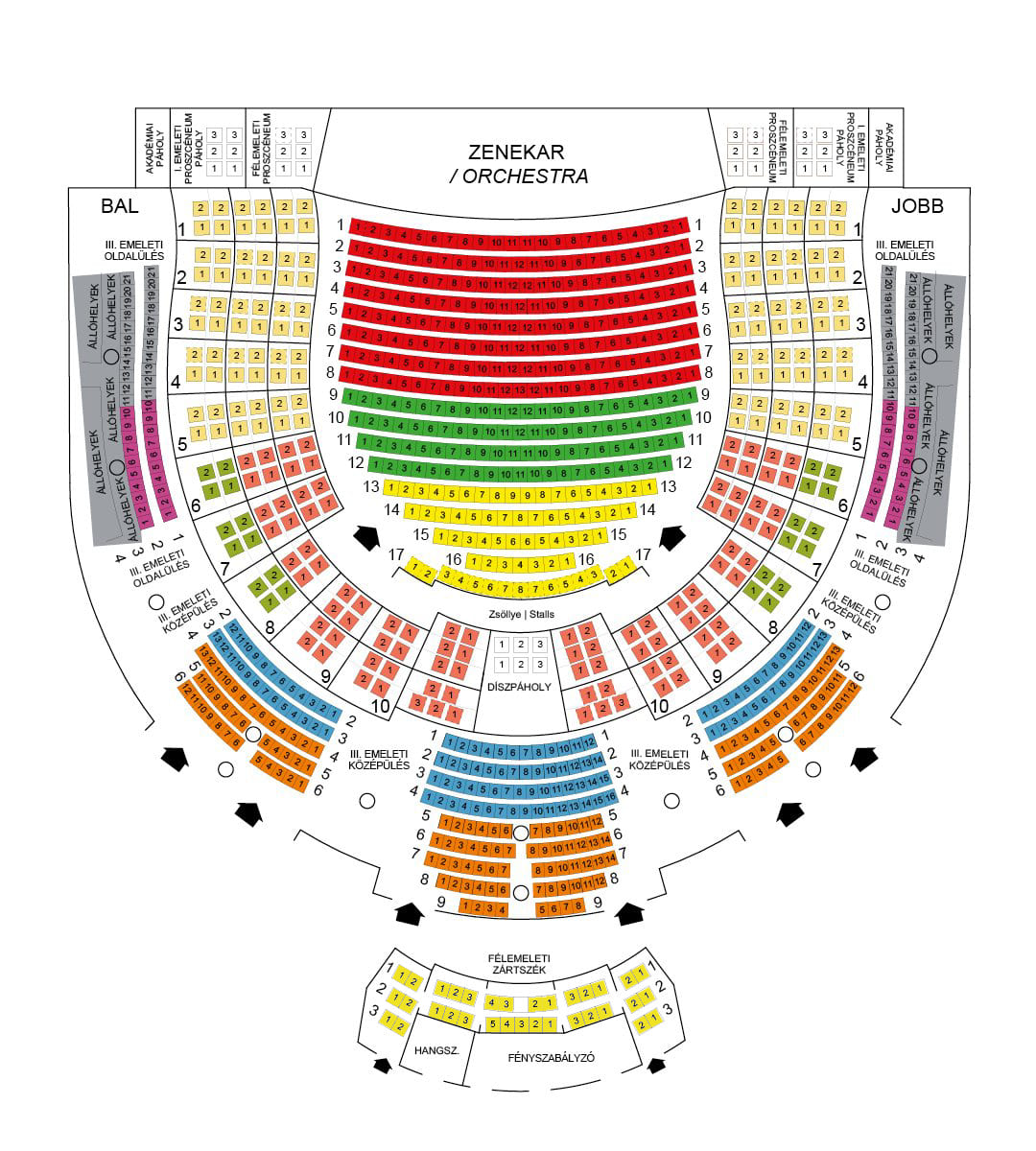
STANDING ROOM TICKETS - INFORMATION IN CASE OF A FULL HOUSE!
If all the seats are sold out for the selected time, but you still want to see the production on that day, 84 of the extremely affordable standing seats will be sold at the theatre, 2 hours before the start of the performance, with which you can visit the gallery on the 3rd floor. Tickets can be purchased at the ticket office of the Budapest Opera House. We would like to draw your attention to the fact that the stage can only be seen to a limited extent from the standing places and the side seats, but at the same time, following the performance is also supported by television broadcasting on the spot.
The Opera House is not only one of the most significant art relic of Budapest, but the symbol of the Hungarian operatic tradition of more than three hundred years as well. The long-awaited moment in Hungarian opera life arrived on September 27, 1884, when, in the presence of Franz Joseph I. the Opera House was opened amid great pomp and ceremony. The event, however, erupted into a small scandal - the curious crowd broke into the entrance hall and overran the security guards in order to catch a glimpse of the splendid Palace on Sugar út. Designed by Mikós Ybl, a major figure of 19th century Hungarian architecture, the construction lived up to the highest expectations. Ornamentation included paintings and sculptures by leading figures of Hungarian art of the time: Károly Lotz, Bertalan Székely, Mór Than and Alajos Stróbl. The great bronze chandelier from Mainz and the stage machinery moda by the Asphaleia company of Vienna were both considered as cutting-edge technology at that time.
Many important artists were guests here including Gustav Mahler, the composer who was director in Budapest from 1887 to 1891. He founded the international prestige of the institution, performing Wagner operas as well as Magcagni’ Cavalleria Rusticana. The Hungarian State Opera has always maintained high professional standards, inviting international stars like Renée Fleming, Cecilia Bartoli, Monserrat Caballé, Placido Domingo, Luciano Pavarotti, José Cura, Thomas Hampson and Juan Diego Flórez to perform on its stage. The Hungarian cast include outstanding and renowed artists like Éva Marton, Ilona Tokody, Andrea Rost, Dénes Gulyás, Attila Fekete and Gábor Bretz.
Gift someone an unforgettable night at the opera. Choose a gift coupon and let them pick the performance they love—music, drama, and world-class artistry, all in one elegant experience.
 en
en 
 de
de it
it fr
fr es
es ru
ru jp
jp ro
ro








 Hungarian State Opera
 Sat 06 Feb 2027 - Thu 18 Feb 2027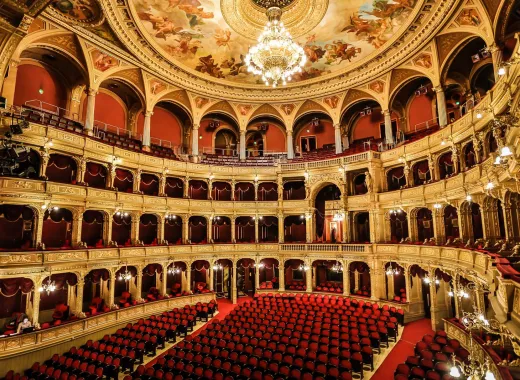



 RM Europa Ticket GmbH
  Call now
 Book now