


en
en v
Phone
Cart0 Tickets
Total: 0€
Account
Calendar
Search
Menu
X

Eugene Onegin

VenueCarlo Felice Theater
CalendarFri 16 Apr 2027 - Wed 21 Apr 2027
Synopsis/Details

Synopsis


Act 1

Scene 1: The garden of the Larin country estate

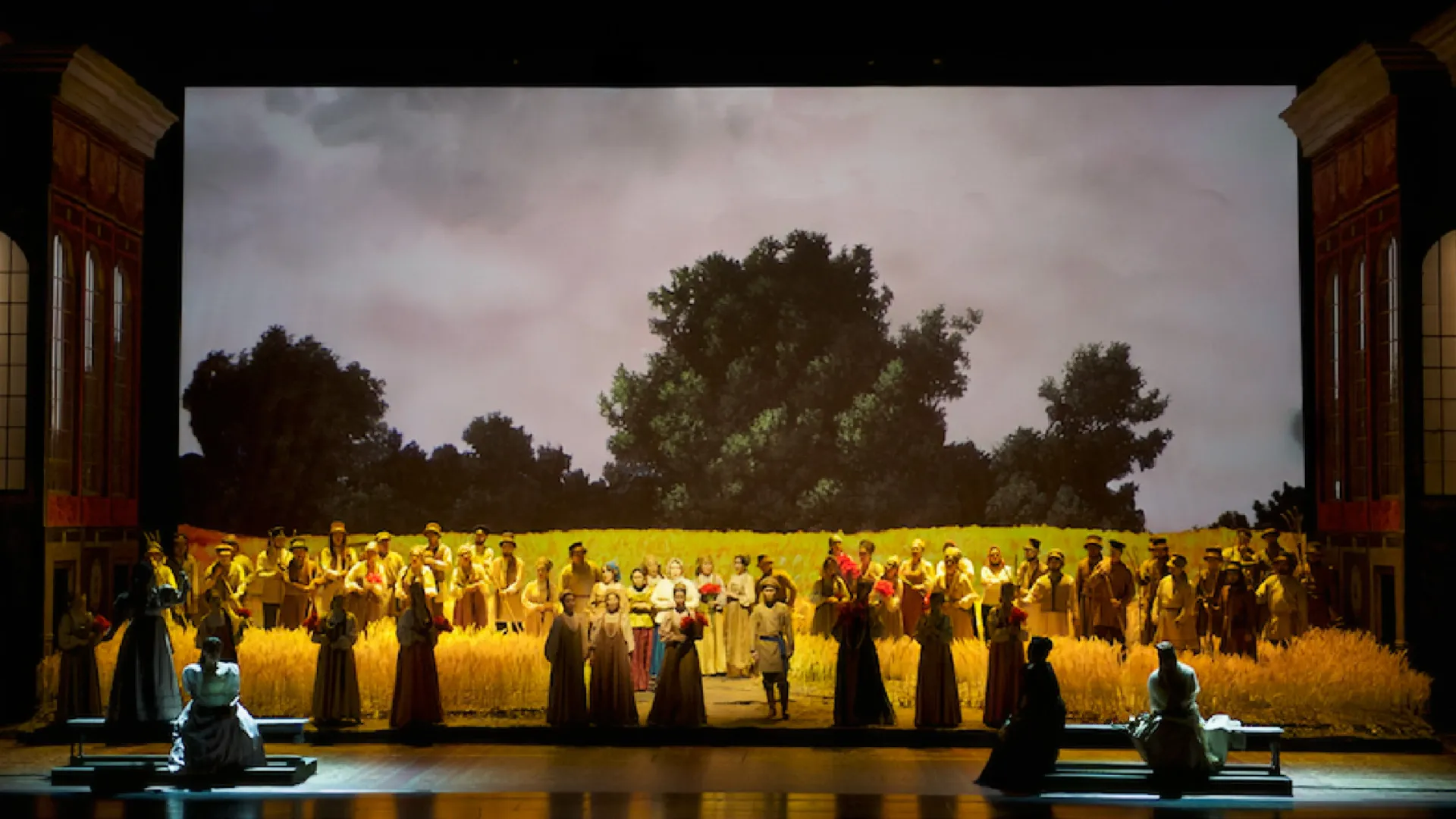
Madame Larina and the nurse Filippyevna are sitting outside in the garden. They can hear Madame Larina's two daughters, Tatyana and her younger sister Olga, singing a love song. Madame Larina begins to reminisce about her own courtship and marriage. A group of peasants enter, and celebrate the harvest with songs and dances. Tatyana and Olga watch. Tatyana has been reading a romantic novel and is absorbed by the story; her carefree sister, on the other hand, wants to join in the celebrations. Madame Larina tells Tatyana that real life is very different from her novels. Filippyevna announces that visitors have arrived: Olga's fiancé Lensky, a young poet, and his friend Eugene Onegin, visiting the area from St Petersburg. The pair are shown in and Lensky introduces Onegin to the Larin family. Onegin is initially surprised that Lensky has chosen the extrovert Olga rather than her more subtle elder sister as his fiancée. Tatyana for her part is immediately and strongly attracted to Onegin. Lensky expresses his delight at seeing Olga and she responds flirtatiously. Onegin tells Tatyana of his boredom in the country and describes the death of his uncle and his subsequent inheritance of a nearby estate. Filippyevna recognizes that Onegin has had a profound effect on Tatyana.

Scene 2: Tatyana's room

Tatyana is dressed for bed. Restless and unable to sleep, she asks her nurse Filippyevna to tell her about her youth and early marriage. Tatyana confesses that she is in love. Left alone, Tatyana pours out her feelings in a letter to Onegin. She tells him that she loves him and believes that she will never feel this way about anyone else, and begs him to understand and help her. She finishes writing the letter at dawn. A shepherd's pipe is heard in the distance. Filippyevna enters the room to wake Tatyana. Tatyana persuades her to send her grandson to deliver the letter to Onegin.

Scene 3: Another part of the estate

Servant girls pick fruit and sing as they work. Tatyana waits anxiously for Onegin's arrival. Onegin enters to see Tatyana and give her his answer to her letter. He explains, not unkindly, that he is not a man who loves easily and is unsuited to marriage. He is unworthy of her love and can only offer her brotherly affection. He warns Tatyana to be less emotionally open in the future. The voices of the servant girls singing are heard again. Tatyana is crushed and unable to reply.


Act 2

Scene 1: The ballroom of the Larin house

A ball is being given in honour of Tatyana, whose name day it is. Onegin is dancing with her. He grows irritated with a group of neighbours who gossip about him and Tatyana, and with Lensky for persuading him to come to the ball. He decides to avenge himself by dancing and flirting with Olga. Lensky is astounded and becomes extremely jealous. He confronts Olga but she cannot see that she has done anything wrong and tells Lensky not to be ridiculous. Onegin asks Olga to dance with him again and she agrees, as "punishment" for Lensky's jealousy. The elderly French tutor Monsieur Triquet sings some couplets in honour of Tatyana, after which the quarrel between Lensky and Onegin becomes more intense. Lensky renounces his friendship with Onegin in front of all the guests, and challenges Onegin to a duel, which the latter is forced, with many misgivings, to accept. Tatyana collapses and the ball ends in confusion.

Scene 2: On the banks of a wooded stream, early morning

Lensky is waiting for Onegin with his second Zaretsky. Lensky reflects on his life, his fear of death and his love for Olga. Onegin arrives with his manservant Guillot. Both Lensky and Onegin are reluctant to go ahead with the duel, reflecting on the senselessness of their sudden enmity. But it is too late; neither man has the courage to stop the duel. Zaretsky gives them the signal and Onegin shoots Lensky dead.


Act 3

Scene 1: The house of a rich nobleman in St Petersburg

Years have passed, during which Onegin has travelled extensively around Europe. Standing alone at a ball, he reflects on the emptiness of his life and his remorse over the death of Lensky. Prince Gremin enters with Tatyana, his wife, now a grand, aristocratic beauty. She is greeted by many of the guests with great deference. Onegin is taken aback when he sees Tatyana, and deeply impressed by her beauty and noble bearing. Tatyana, in turn, is overwhelmed with emotion when she recognizes him. Gremin tells Onegin about his great happiness and love for Tatyana, and re-introduces Onegin to his wife. Onegin, suddenly injected with new life, realizes that he is in love with Tatyana. He determines to write to her and arrange a meeting.

Scene 2: A room in Prince Gremin's house

Tatyana has received Onegin's letter, which has stirred up the passion she felt for him as a young girl and disturbed her. Onegin enters. Tatyana recalls her earlier feelings and asks why Onegin is pursuing her now. Is it because of her social position? Onegin denies any cynical motivation: his passion is real and overwhelming. Tatyana, moved to tears, reflects how near they once were to happiness but nevertheless asks him to leave. He asks her to have pity. Tatyana admits she still loves Onegin, but asserts that their union can never be realized, as she is now married, and determined to remain faithful to her husband despite her true feelings. Onegin implores her to relent, but she bids him farewell forever, leaving him alone and in despair.

  • Where is Teatro Carlo Felice located?
    • Teatro Carlo Felice is located at Passo Eugenio Montale 4, 16121 Genoa, Italy, next to Piazza De Ferrari in the city centre. 
  • How early should I arrive at the theatre?
    • We recommend arriving at least 30 minutes before the scheduled start time to allow enough time to find the entrance, present your ticket and locate your seat. Please arrive on time, as latecomers may not be allowed into the auditorium once the performance has started. 
  • Is there a dress code at Teatro Carlo Felice?
    • Yes. Visitors are expected to wear clothing appropriate for a theatre setting. Casual but smart attire is recommended. Tank tops, shorts and beachwear, including flip-flops and swimsuits, are not permitted.
  • Is Teatro Carlo Felice accessible to visitors with reduced mobility?
    • Yes. The theatre has wheelchair-accessible routes and accessible toilets. Visitors who require assistance are encouraged to contact the theatre in advance to confirm arrangements for their specific seating area.
  • Can I take photographs or record the performance?
    • No. Photography, audio recording and video recording inside the theatre are prohibited during performances. Mobile phones and other electronic devices should be switched off or set to silent mode.
Cast

An Opera in Three Acts
Libretto by Pyotr Ilyich Tchaikovsky
and Konstantin Shilovsky

Music by Pëtr Il’ič Čajkovskij

Conductor:
Yerbolat Akhmedyarov

Director:
Davide Livermore

Scenes:
Francesco Calcagnini

Costumes:
Sofia Tasmagambetova
Pavel Dragunov

Choreography:
Elena Sherstneva

Lighting:
Vincenzo Raponi

Set design for the Astana Opera

Soloists and production by the Astana Opera

Orchestra and Chorus of the Carlo Felice Theater in Genoa

Chorus Master:
Giulio Magnanini

Venue
Carlo Felice Theater

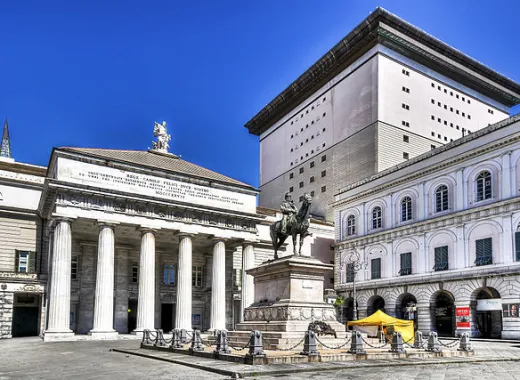
  Built on the area of Carlo Felice, the new theater, built by Aldo Rossi, recovers an idea already present in Paul Chessa projects and Carlo Scarpa: the creation of a piazza covered with 400 square meters, where the theater it was the ideal link between Galleria Mazzini and Piazza De Ferrari. Distant instead from an architectural point of view are the same Galleria Mazzini and the theater. the square is an open foyer; the walls are covered with stone slabs, and are enriched with columns and metal beams. There are two requirements that the architects wanted to keep in mind in the implementation of the new Carlo Felice theater: first, the need to rebuild it exactly where it was and secondly the desire to equip the new facility with the latest technology. From the latter need arises the imposing fly tower about 63 meters high. In practice the old theater work of Barabino remain the columns, the portico, the Latin inscription and the terrace that overlooks Via XXV Aprile which is accessed by one of the foyer; the current structure is very compact and geometric, the fly tower is a very linear in height developed rectangular, adorned only by a cornice.The auditorium, the foyer and services for the public are contained in a smaller box, where they emphasize the porch and the porch. As for the construction of the new theater are the stone were used for the exterior, plaster and iron, for the interior marble and wood. It is durable material that suggests an image of eternity, security and survival of the building over time. From the covered square, descending a staircase, you enter a room with a capacity of about 200 seats. Equipped with a small stage and independent from the rest of the theater, the hall hosts conferences, lectures and musical events. The interior of the theater entrance wide staircase leads to the closet and still climbing, the first foyer which has an area of 660 square meters and is decorated with frescoes and tapestries. the lantern A characteristic feature of the new Carlo Felice is the lantern visible in the foyer overlooking the lobby; it's a kind a light cone that runs through the building in all its height and it runs through all the plans, bringing the light from the roof to the indoor square. The tower Absolutely unique is the scenario in which they operate the technical units; right in the scenic tower, which houses the machine to move the shows, come together in a delicate balance human labor and sophisticated gear.In fact, the theater has four stages, a main stage, a back stage behind the first two stages and less aligned with each other and managed by integrated electronic and computerized. These scenic handling facilities, computerized lighting, sophisticated booths director for filming and acoustics among the best in Italy are among the features that make the Carlo Felice a factory of emotions among the most important in Italy.


 

Buy now

Gift vouchers

Gift someone an unforgettable night at the opera.
Choose a gift coupon and let them pick the performance they love—music, drama, and world-class artistry, all in one elegant experience.
Official Tickets for Europe's Most Famous Opera Houses, Classical Concerts etc.
Instagram
Payment
Google Play
App Store
© 2026 RM Europa Ticket GmbH
Whatsapp