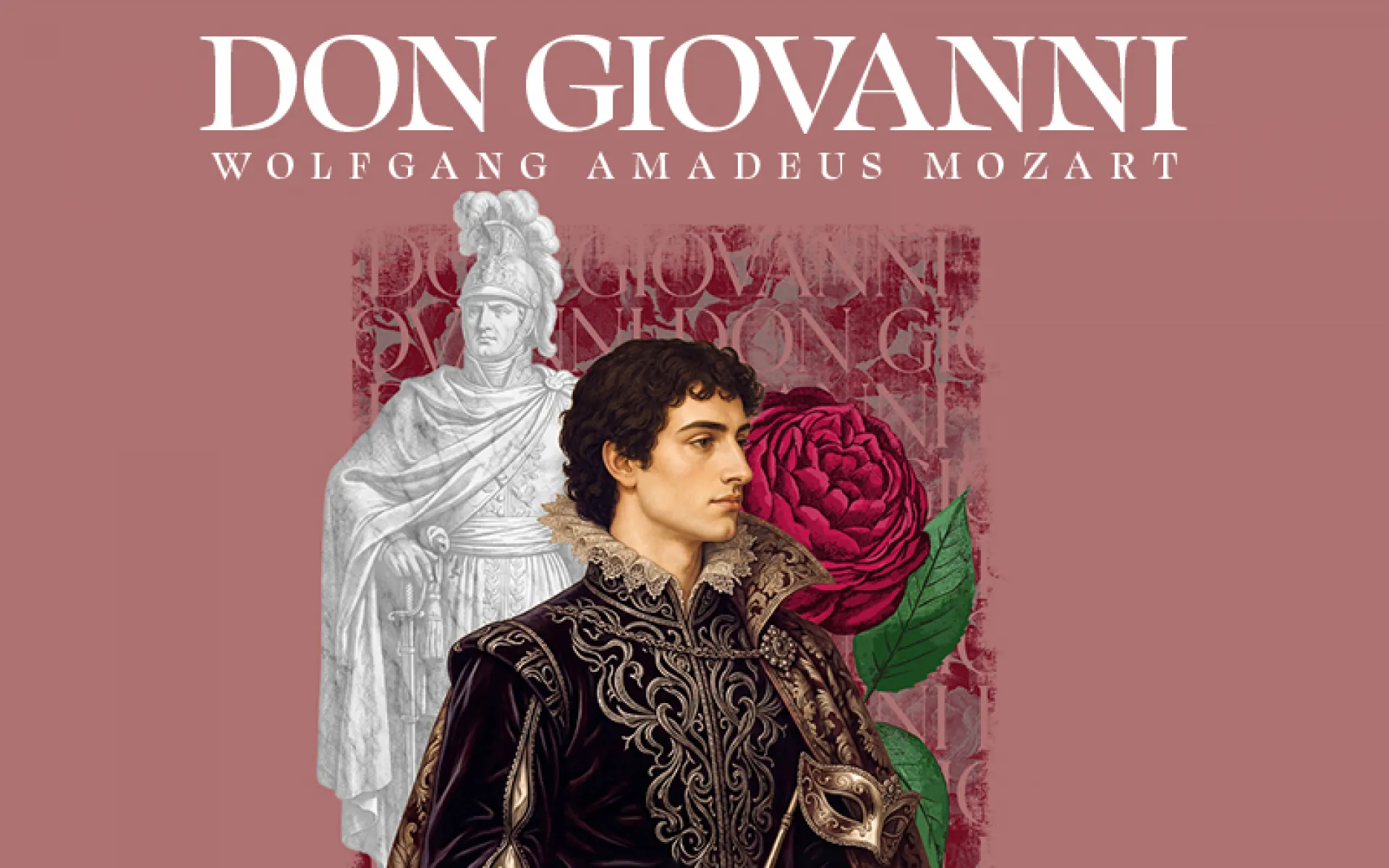
Don Giovanni – Wolfgang Amadeus Mozart
Opera sung in Italian, with Italian and English surtitles
OPERA AND BALLET SEASON 2026-27
15, 16, 17, 21, 23, 24 January 2027
Synopsis
Don Giovanni, a young, arrogant, and sexually promiscuous nobleman, abuses and outrages everyone else in the cast until he encounters something he cannot kill, beat up, dodge, or outwit.
Act 1
The overture begins with a thundering D minor cadence, followed by a short misterioso sequence which leads into a light-hearted D major allegro.
The garden of the Commendatore
Leporello, Don Giovanni's servant, grumbles about his demanding master and daydreams about being free of him ("Notte e giorno faticar" – "Night and day I slave away"). He is keeping watch while Don Giovanni is in the Commendatore's house attempting to seduce the Commendatore's daughter, Donna Anna.[d] Don Giovanni enters the garden from inside the house, pursued by Donna Anna. Don Giovanni is masked and Donna Anna tries to hold him and to unmask him, shouting for help. (Trio: "Non sperar, se non m'uccidi, Ch'io ti lasci fuggir mai!" – "Do not hope, unless you kill me, that I shall ever let you run away!"). He breaks free and she runs off as the Commendatore enters the garden. The Commendatore blocks Don Giovanni's path and forces him to fight a duel. Don Giovanni kills the Commendatore with his sword and escapes with Leporello. Donna Anna, returning with her fiancé, Don Ottavio, is horrified to see her father lying dead in a pool of his own blood. She makes Don Ottavio swear vengeance against the unknown murderer. (Duet: "Ah, vendicar, se il puoi, giura quel sangue ognor!" – "Ah, swear to avenge that blood if you can!")
A public square outside Don Giovanni's palace
Leporello tells Don Giovanni that he (Giovanni) is leading a rotten life; Don Giovanni reacts angrily. They hear a woman (Donna Elvira) singing of having been abandoned by her lover, on whom she is seeking revenge ("Ah, chi mi dice mai" – "Ah, who could ever tell me"). Don Giovanni starts to flirt with her, but it turns out he is the former lover she is seeking. The two recognise each other and she reproaches him bitterly. He shoves Leporello forward, ordering him to tell Donna Elvira the truth about him, and then hurries away.
Leporello tells Donna Elvira that Don Giovanni is not worth her feelings for him. He is unfaithful to everyone; his conquests include 640 women and girls in Italy, 231 in Germany, 100 in France, 91 in Turkey, but in Spain, 1,003 ("Madamina, il catalogo è questo" – "My dear lady, this is the catalogue"). In a frequently cut recitative, Donna Elvira vows vengeance.
The open country
A marriage procession with Masetto and Zerlina enters. Don Giovanni and Leporello arrive soon after. Don Giovanni is immediately attracted to Zerlina, and he attempts to remove the jealous Masetto by offering to host a wedding celebration at his castle. On realising that Don Giovanni means to remain behind with Zerlina, Masetto becomes angry ("Ho capito! Signor, sì" – "I understand! Yes, my lord!") but is forced to leave. Don Giovanni and Zerlina are soon alone and he immediately begins his seductive arts (Duet: "Là ci darem la mano" – "There we will entwine our hands").
Donna Elvira arrives and thwarts the seduction ("Ah, fuggi il traditor" – "Flee from the traitor!"). She leaves with Zerlina. Don Ottavio and Donna Anna enter, plotting vengeance on the still unknown murderer of Donna Anna's father. Donna Anna, unaware that she is speaking to her attacker, pleads for Don Giovanni's help. Don Giovanni, relieved that he is unrecognised, readily promises it, and asks who has disturbed her peace. Before she can answer, Donna Elvira returns and tells Donna Anna and Don Ottavio that Don Giovanni is a false-hearted seducer. Don Giovanni tries to convince Don Ottavio and Donna Anna that Donna Elvira is insane (Quartet: "Non ti fidar, o misera" – "Don't trust him, oh sad one"). As Don Giovanni leaves, Donna Anna suddenly recognises him as her father's murderer and tells Don Ottavio the story of his intrusion, claiming that she was deceived at first because she was expecting a night visit from Don Ottavio himself, but managed to fight Don Giovanni off after discovering the impostor (long recitative exchange between Donna Anna and Don Ottavio). She repeats her demand that he avenge her and points out that he will be avenging himself as well (aria: "Or sai chi l'onore Rapire a me volse" – "Now you know who wanted to rob me of my honour"). In the Vienna version, Don Ottavio, not yet convinced (Donna Anna having only recognised Don Giovanni's voice, not seen his face), resolves to keep an eye on his friend ("Dalla sua pace la mia dipende" – "On her peace my peace depends").
Leporello informs Don Giovanni that all the guests of the peasant wedding are in Don Giovanni's house and that he distracted Masetto from his jealousy, but that Zerlina, returning with Donna Elvira, made a scene and spoiled everything. However, Don Giovanni remains cheerful and tells Leporello to organise a party and invite every girl he can find. (Don Giovanni's "Champagne Aria": "Fin ch'han dal vino calda la testa" – "Till they are tipsy"). They hasten to his palace.
A garden outside Don Giovanni's palace
Zerlina follows the jealous Masetto and tries to pacify him ("Batti, batti o bel Masetto" – "Beat, O beat me, handsome Masetto"), but just as she manages to persuade him of her innocence, Don Giovanni's voice from offstage startles and frightens her. Masetto hides, resolving to see for himself what Zerlina will do when Don Giovanni arrives. Zerlina tries to hide from Don Giovanni, but he finds her and attempts to continue the seduction, until he stumbles upon Masetto's hiding place. Confused but quickly recovering, Don Giovanni reproaches Masetto for leaving Zerlina alone, and returns her temporarily to him. Don Giovanni then leads both offstage to his ballroom. Three masked guests – the disguised Don Ottavio, Donna Anna, and Donna Elvira – enter the garden. From a balcony, Leporello invites them to his master's party. They accept the invitation and Leporello leaves the balcony. Alone, Don Ottavio and Donna Anna pray for protection, Donna Elvira for vengeance (Trio: "Protegga il giusto cielo" – "May the just heavens protect us").
Don Giovanni's ballroom
As the merriment, featuring three separate chamber orchestras on stage, proceeds, Leporello distracts Masetto by dancing with him, while Don Giovanni leads Zerlina offstage to a private room and tries to assault her. When Zerlina screams for help, Don Giovanni drags Leporello onstage from the room, accuses Leporello of assaulting Zerlina himself, and threatens to kill him. The others are not fooled. Don Ottavio produces a pistol and points it at Don Giovanni, and the three guests unmask and declare that they know all. But despite being denounced and menaced from all sides, Don Giovanni remains calm and escapes – for the moment.
Act 2
Outside Donna Elvira's house
Leporello threatens to leave Don Giovanni, but his master calms him with a peace offering of money (Duet: "Eh via buffone" – "Go on, fool"). Wanting to seduce Donna Elvira's maid, and believing that she will trust him better if he appears in lower-class clothes, Don Giovanni orders Leporello to exchange cloak and hat with him. Donna Elvira comes to her window (Trio: "Ah taci, ingiusto core" – "Ah, be quiet unjust heart"). Seeing an opportunity for a game, Don Giovanni hides and sends Leporello out in the open wearing Don Giovanni's cloak and hat. From his hiding place Don Giovanni sings a promise of repentance, expressing a desire to return to her and threatening to kill himself if she does not take him back, while Leporello poses as Don Giovanni and tries to keep from laughing. Donna Elvira, convinced, descends to the street. Leporello, continuing to pose as Don Giovanni, leads her away to keep her occupied while Don Giovanni serenades her maid with his mandolin. ("Deh, vieni alla finestra" – "Ah, come to the window").
Before Don Giovanni can complete his seduction of the maid, Masetto and his friends arrive, looking for Don Giovanni in order to kill him. Don Giovanni poses as Leporello (whose clothes he is still wearing) and joins the posse, pretending that he also hates Don Giovanni. After cunningly dispersing Masetto's friends (Don Giovanni aria: "Metà di voi qua vadano" – "Half of you go this way. the others, go that way"), Don Giovanni takes Masetto's weapons away, beats him up, and runs off, laughing. Zerlina arrives and consoles the bruised and battered Masetto ("Vedrai carino" – "You'll see, dear one").
A dark courtyard
Leporello abandons Donna Elvira. (Sextet: "Sola, sola in buio loco" – "All alone in this dark place"). As he tries to escape, he bumps into Don Ottavio and Donna Anna. Zerlina and Masetto also enter the scene. Everyone mistakes Leporello for Don Giovanni, whose clothes he is still wearing. They surround Leporello and threaten to kill him. Donna Elvira tries to protect the man who she thinks is Don Giovanni, claiming him as her husband and begging the others to spare him. Leporello takes off Don Giovanni's cloak and reveals his true identity. He begs for mercy and, seeing an opportunity, runs off (Leporello aria: "Ah pietà signori miei" – "Ah, have mercy, my lords"). Don Ottavio is now convinced that Don Giovanni murdered Donna Anna's father (the deceased Commendatore). He swears vengeance ("Il mio tesoro" – "My treasure" – though in the Vienna version this was cut).
In the Vienna production of the opera, Zerlina follows Leporello and recaptures him. Threatening him with a razor, she ties him to a stool. He attempts to sweet-talk her out of hurting him. (Duet: "Per queste tue manine" – "For these hands of yours"). Zerlina goes to find Masetto and the others; Leporello escapes again before she returns. This scene, marked by low comedy, is rarely performed today. Also in the Vienna production, Donna Elvira is still furious at Don Giovanni for betraying her, but she also feels sorry for him. ("Mi tradì quell'alma ingrata" – "That ungrateful wretch betrayed me").
A graveyard with the statue of the Commendatore
Don Giovanni wanders into a graveyard. Leporello arrives and the two reunite. Leporello tells Don Giovanni of his brush with danger, and Don Giovanni laughingly taunts him, saying that he took advantage of his disguise as Leporello by trying to seduce one of Leporello's girlfriends. The voice of the statue interrupts and warns Don Giovanni that his laughter will not last beyond sunrise. At the command of his master, Leporello reads the inscription upon the statue's base: "Here am I waiting for revenge against the scoundrel who killed me" ("Dell'empio che mi trasse al passo estremo qui attendo la vendetta"). The servant trembles, but Don Giovanni scornfully orders him to invite the statue to dinner, and threatens to kill him if he does not. Leporello makes several attempts to invite the statue to dinner, but is too frightened to complete the invitation (Duet: "O, statua gentilissima" – "Oh most noble statue"). Don Giovanni invites the statue to dinner himself. Much to his surprise, the statue nods its head and responds affirmatively.
Donna Anna's room
Don Ottavio pressures Donna Anna to marry him, but she thinks it is inappropriate so soon after her father's death. He accuses her of being cruel, and she assures him that she loves him, and is faithful ("Non mi dir" – "Tell me not").
Don Giovanni's chambers
"Don Giovanni, a cenar teco"
Duration: 7 minutes and 13 seconds.7:13
Kurt Böhme (Commendatore), Cesare Siepi (Don Giovanni), Fernando Corena (Leporello); Vienna Philharmonic, Josef Krips (1955)
Don Giovanni revels in the luxury of a great meal, served by Leporello, and musical entertainment during which the orchestra plays music from popular (at the time) late-18th-century operas: "O quanto un sì bel giubilo" from Vicente Martín y Soler's Una cosa rara (1786), "Come un agnello" from Giuseppe Sarti's Fra i due litiganti il terzo gode (1782), and finally "Non più andrai" from Mozart's own The Marriage of Figaro (1786). Leporello comments that he is all too familiar with the final tune (Questa poi la conosco purtroppo) – likely a joke understandable for the original audience, as Felice Ponziani, who sang Leporello's part at the premiere, also sang Figaro's part (including "Non più andrai") earlier in Prague.[21][f] (Finale "Già la mensa è preparata" – "Already the table is prepared"). Donna Elvira enters, saying that she no longer feels resentment against Don Giovanni, only pity for him. ("L'ultima prova dell'amor mio" – "The final proof of my love"). Don Giovanni, surprised, asks what she wants, and she begs him to change his life. Don Giovanni taunts her and then turns away, praising wine and women as the "support and glory of humankind" (sostegno e gloria d'umanità). Hurt and angry, Donna Elvira gives up and leaves. Offstage, she screams in sudden terror. Don Giovanni orders Leporello to see what has upset her; when he does, he also cries out, and runs back into the room, stammering that the statue has appeared as promised. An ominous knocking sounds at the door. Leporello, paralyzed by fear, cannot answer it, so Don Giovanni opens it himself, revealing the statue of the Commendatore. With the rhythmic chords of the overture, now reharmonized with diabolic diminished sevenths accompanying the Commendatore ("Don Giovanni! A cenar teco m'invitasti" – "Don Giovanni! You invited me to dine with you"), the statue asks if Don Giovanni will now accept his invitation to dinner. Don Giovanni brazenly accepts, and shakes the statue's proffered hand, only to collapse as he is overcome by sudden chills. The statue offers him a final chance to repent as death draws near, but Don Giovanni adamantly refuses. The statue disappears and Don Giovanni cries out in pain and terror as he is surrounded by a chorus of demons, who carry him down to Hell. Leporello, watching from under the table, also cries out in fear.
Donna Anna, Don Ottavio, Donna Elvira, Zerlina, and Masetto arrive, searching for the villain. They find instead Leporello hiding under the table, shaken by the supernatural horror he has witnessed. He assures them that no one will ever see Don Giovanni again. The remaining characters announce their plans for the future: Donna Anna and Don Ottavio will marry when Donna Anna's year of mourning is over; Donna Elvira will withdraw from society for the rest of her life;[g] Zerlina and Masetto will finally go home for dinner; and Leporello will go to the tavern to find a better master.
The concluding ensemble delivers the moral of the opera – "Such is the end of the evildoer: the death of a sinner always reflects his life" (Questo è il fin di chi fa mal, e de' perfidi la morte alla vita è sempre ugual). As mentioned above, productions for over a century – beginning with the original run in Prague – customarily omitted the final ensemble, but it frequently reappeared in the 20th century and productions of the opera now usually include it. The return to D major and the innocent simplicity of the last few bars conclude the opera.
 en
en 
 de
de it
it fr
fr es
es ru
ru jp
jp ro
ro







 Teatro Verdi Trieste
 Fri 15 Jan 2027 - Sun 24 Jan 2027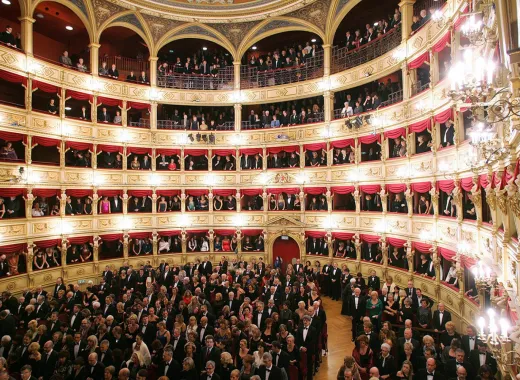



 RM Europa Ticket GmbH
  Call now
 Book now