
 EN
EN DE
DE IT
IT FR
FR ES
ES RU
RU JP
JP RO
RO
© Wiener Staatsoper
Tristan and Isolde
Order tickets
April 2027 | ||||||
|---|---|---|---|---|---|---|
Mo | Tu | We | Th | Fr | Sa | Su |
Tristan and Isolde – Richard Wagner | Opera
Drama in three acts
Text: Richard Wagner
Language: German
Isolde loves Tristan, and Tristan loves Isolde. A love without alternatives, a love without hope, since Isolde is to marry King Marke in order to seal peace between Ireland and Cornwall.
Tristan accompanies her, torn between contempt and despair, on her journey to Cornwall. “Chosen for me, lost to me,” sings Isolde about Tristan, and continues: “Doomed head! Doomed heart!” Only in death does their love seem possible. However, Isolde’s confidante Brangäne administers, instead of the requested poison, a love potion, and the fate of the two “devoted to night” takes its course.
Act 1 – approx. 80 min
Interval – approx. 35 min
Act 2 – approx. 75 min
Interval – approx. 35 min
Act 3 – approx. 75 min
Synopsis
Act 1 - 3
Tristan, the adopted son of King Mark of England, is at the helm of a ship. Tristan brings Isolde, the king's daughter of the subjugated Irish, to England.
There he will marry her off to the widowed Marke in order to strengthen the alliance between the two peoples - and his own position of power. On board, he keeps his distance from Isolde. Instead of treating her with the respect she deserves, he mocks her in a mocking song that the entire crew joins in with.
Isolde reveals the story to her confidante Brangäne: During the war, Tristan had killed Isolde's fiancé Morold. However, he had suffered a poisoned wound from the duel. The ailing Tristan set himself adrift in a boat off the coast of Ireland to be cared for by Isolde as the minstrel "Tantris", as he could only hope to recover from her healing skills. Isolde recognized him as the murderer of her fiancé and yet was unable to take revenge when the sick man looked her in the eye.
the cured "Tantris" returned under his true name as King Mark's suitor. The beaten Irish had no choice but to accept this proposal. When Brangäne points out the magic potions she had smuggled on board, which could perhaps turn everything around, the deeply humiliated Isolde decides to poison Tristan and herself. But instead of the poison, Brangäne gives the two mortal enemies a love potion that condemns them to the delights and torments of unquenchable longing.
Program and cast
Tristan: Andreas Schager
King Marke: Kwangchul Youn
Isolde: Miina-Liisa Värelä
Kurwenal: Adrian Eröd
Brangäne: Tanja Ariane Baumgartner
Musical Direction: Alexander Soddy
Staging: Calixto Bieito
Set Design: Rebecca Ringst
Costumes: Ingo Krügler
Lighting: Michael Bauer
Vienna State Opera
Public Transport
Subway lines: U1, U2, U4
Trams: 1, 2, D, J, 62, 65
Buses: 59A
Local Railway: Badner Bahn
Stops: Karlsplatz / Opera
Taxi stands are available nearby.
Parking
Parking is only € 6, - for eight hours!
The Wiener Staatsoper and the ÖPARK Kärntner Ring Garage on Mahlerstraße 8, under the “Ringstraßengalerien”, offer the patrons of the Vienna State Opera a new, reduced parking fee. You can park in the Kärntner Ring Garage for up to 8 hours and pay only a flat fee of € 6, -. Just validate your ticket at one of the discount machines inside the Wiener Staatsoper. The normal rate will be charged for parking time greater than 8 hours. The validation machines can be found at the following coat checks: Operngasse, Herbert von Karajan-Platz, and the right and left and balcony galleries.
Important: In order to get the discount, please draw a ticket and do not use your credit card when entering the garage!
After devaluing your ticket in the Wiener Staatsoper you can pay comfortably by credit card or cash at the vending machines.
The machines accept coins and bills up to 50.- Euro. Parking time longer than 8 hours will be charged at the normal rate.
History
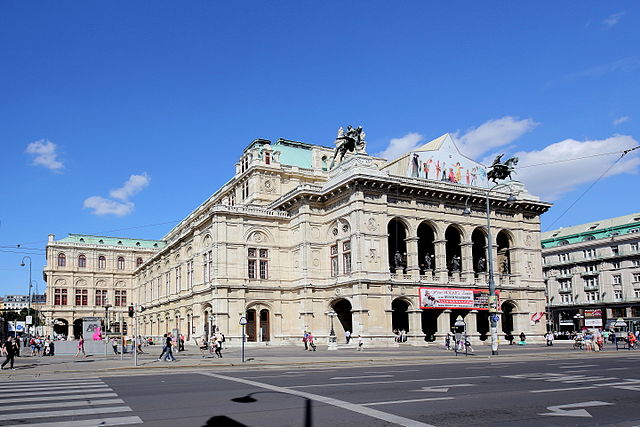
The structure of the opera house was planned by the Viennese architect August Sicard von Sicardsburg, while the inside was designed by interior decorator Eduard van der Nüll. It was also impacted by other major artists such as Moritz von Schwind, who painted the frescoes in the foyer, and the famous "Zauberflöten" (“Magic Flute”) series of frescoes on the veranda. Neither of the architects survived to see the opening of ‘their’ opera house: the sensitive van der Nüll committed suicide, and his friend Sicardsburg died of a stroke soon afterwards.
On May 25, 1869, the opera house solemnly opened with Mozart's Don Giovanni in the presence of Emperor Franz Joseph and Empress Elisabeth.
The popularity of the building grew under the artistic influence of the first directors: Franz von Dingelstedt, Johann Herbeck, Franz Jauner, and Wilhelm Jahn. The Vienna opera experienced its first high point under the direction of Gustav Mahler. He completely transformed the outdated performance system, increased the precision and timing of the performances, and also utilized the experience of other noteworthy artists, such as Alfred Roller, for the formation of new stage aesthetics.
The years 1938 to 1945 were a dark chapter in the history of the opera house. Under the Nazis, many members of the house were driven out, pursued, and killed, and many works were not allowed to be played.
On March 12, 1945, the opera house was devastated during a bombing, but on May 1, 1945, the “State Opera in the Volksoper” opened with a performance of Mozart's THE MARRIAGE OF FIGARO. On October 6, 1945, the hastily restored “Theaters an der Wien” reopened with Beethoven's FIDELIO. For the next ten years the Vienna State Opera operated in two venues while the true headquarters was being rebuilt at a great expense.
The Secretary of State for Public Works, Julius Raab, announced on May 24, 1945, that reconstruction of the Vienna State Opera would begin immediately. Only the main facade, the grand staircase, and the Schwind Foyer had been spared from the bombs. On November 5, 1955, the Vienna State Opera reopened with a new auditorium and modernized technology. Under the direction of Karl Böhm, Beethoven’s FIDELIO was brilliantly performed, and the opening ceremonies were broadcast by Austrian television. The whole world understood that life was beginning again for this country that had just regained its independence.
Today, the Vienna State Opera is considered one of the most important opera houses in the world; in particular, it is the house with the largest repertoire. It has been under the direction of Dominique Meyer since September 1, 2010.
© Wiener Staatsoper
Related events