Tosca – Giacomo Puccini | Opera IC Audiophile series
Running time: 2 hours 45 minutes including one interval
Language: Italian
Surtitle: Hungarian, English, Italian
There are evenings when our Opera House cannot perform because rehearsals are ongoing on stage until the evening. There are audience members who can only afford to hear their favourite pieces with a discount. And there are works that, although very popular, cannot be staged every season due to the congestion of productions. All these issues can be solved at once by the Hungarian State Opera’s new IC series, whose name carries the of iron curtain, but which may also gain popularity with the speed of an express train. Even though it will feature in the programme as a regular series beginning only with the next season, we are already presenting this new, semi-staged operatic format that offers more than concert performances on selected evenings during the current one as a preview. The titles are major works by great composers, requiring smaller choruses but offering fewer but particularly significant soloist roles.
A mere hour after a stage rehearsal, visitors having purchased their ticket with a 20% discount find the iron curtain of the Opera House lowered. The massive double steel plate, covering a surface of 170 m², does not only conceal the set of the next production behind it but also serve as an acoustic reflector meeting audiophile standards. Onto this enormous surface, decorated with architect Miklós Ybl’s engravings, we project a unique video installation, with Hungarian and English surtitles displayed at the top. The orchestra takes its usual place in the pit, while the hand-picked, first-rate singers step through the door in the iron curtain to take a seat at the front of the stage, then step into the limelight when it is their turn to sing.
The form is quasi-concert-like, but the soloists do not use sheet music, they appear in period costumes, and can use their faces, hands, and bodies for dramatic gestures. The participating chorus performs from various points of the building to astonish the audience with a powerful 3D sound. From all this, a single, significant, shared experience can emerge: the wonder of sound that feels much closer to the audience, magnifying gestures and offering a far more intense, truly record-quality experience in an auditorium that is thus transformed into one with the best acoustics in Hungary, the concert hall of the Opera House.
In the 2026/27 season, audiophile concert performances of Bluebeard's Castle, Don Giovanni, Rigoletto, and Tosca continue the series started in 2025.
Parental guidance: The performance is not recommended for children under 12 years of age.
Synopsis
Act I
Angelotti, a political refugee has escaped from prison and seeks refuge in the church where his sister, Attavanti has deposited female clothes, a veil, and a fan for his flight. Angelotti conceals himself when the Sacristan arrives looking for the painter Cavaradossi. The Sacristan is outraged by the altar painting on which the painter is working: the figure of St Magdalena resembles the features of a beautiful unknown woman (Attavanti) who has often been observed at prayer in the church recently. Observing the painting, Cavaradossi thinks of two faces: the blonde stranger who has, unknowingly, served as a model for him, and the one his heart belongs to, the brown-haired, black-eyed Tosca. Angelotti comes out from his hiding place. Cavaradossi is prepared to assist his old friend, the fugitive politician, but their conversation is interrupted by the voice of Tosca who has come unexpectedly and uninvited to see her lover. Angelotti returns to his hiding place. Tosca’s jealousy is aroused, perhaps not without any reason, when Cavaradossi does not open the church door at once. Her jealousy gets stronger when she recognizes Attavanti’s features in Cavaradossi's painting. Cavaradossi succeeds in pacifying her, and they confess their love for each other. When Tosca leaves, the painter offers to hide the fugitive in a well in the garden of his house on the confines of the city. A cannon is fired: whether the escape of the fugitive has been discovered, or a great celebration is announced remains to be seen. In any case, the painter and the fugitive take their leave together.
Choirboys flock into the church preparing for a joyful Te Deum exulting over the news of military victory. A celebratory feast is planned for the evening with Tosca singing a new cantata. Scarpia, the much-feared chief of police enters the church with his benchmen who become aware of suspicious clues: Attavanti’s fan, the open door of the chapel, and an empty food basket. Scarpia also recognises Attavanti’s features in the painting, and when he learns that it was created by Cavaradossi, he realises how the escape and the subsequent flight must have happened. His heart is filled with a twofold desire for revenge, to crush those with different opinions, and win Cavaradossi’s sweetheart, Tosca, who returns abruptly. The chief of police approaches her as a gentleman, he first appeals to hear religious emotions, then he inflames her jealousy indicating the fan and the painting. Tosca almost loses her wits and flees lest she expose her unfaithful lover. However, she is used by Scarpia as a peregrine falcon and the secret police are led to their aim. At the church, Te Deum sounds, and the devilish Scarpia, a true hypocrite, joins in the sacred song in the knowledge of his victory.
Act II
At the centre of the secret police, Scarpia is awaiting the developments as a bloodthirsty predator. It is night, the sounds of the festive cantata seep in. The desire for Tosca is awakened again in Scarpia, whereas his blood boils from the hatred for Angelotti and Cavaradossi. The detective Spoletta, who has followed Tosca hasn’t found Angelotti but has brought in the painter in the hope of forcing some kind of confession out of him. Scarpia first converses with Cavaradossi to get to know anything about Angelotti, but the stubborn silence of the painter makes him order a torture. At this point, Tosca, having been summoned by the chief of police, enters. Cavaradossi is led into the adjoining room where he withstands the torments. For a while, the diva also manages to hold on, but when Scarpia has the door opened, the cries of Cavaradossi make her give up Angelotti’s hiding place. The unconscious painter is brought to her, and he comes to in Tosca’s arms. Scarpia lets Cavaradossi know that his lover has made a confession, and he goes blind with rage. Sciarrone, Scarpia’s bodyguard bursts in and explains that the battle has taken a turn, and their side has suffered a defeat. Cavaradossi’s joyful exclamation reveals his political views, whereupon Scarpia sentences him to death at once to be carried out at dawn. Tosca, in an attempt to save her lover’s life, offers money to Scarpia, but the man only wants one thing: her. The diva rejects him in disgust, but eventually she breaks and accepts the deal. Scarpia orders Spoletta to pretend to shoot Cavaradossi, but it is pretence as he refers to a certain Count Palmieri in his command that is in fact for a real execution. When he stays alone with Tosca, she grabs a knife at hand and plunges it into Scarpia’s heart before he could rape her.
Act III
It is still night, starry and silent, then the bells of dawn toll, the song of a shepherdess is heard from the distance. Cavaradossi refuses the last rites, he choses to write a message to Tosca. However, she appears in person with the passports explaining why she killed Scarpia. She also tells the painter that the execution will be a pretence as he will be shot at with blanks. The execution squad appears. They fire and Cavaradossi falls dead. Tosca, in hopeless despair, realises that the chief of olice lied even before his death. Shouts are heard announcing that the body of Scarpia has been found, and she ends her own life.
 en
en 
 de
de it
it fr
fr es
es ru
ru jp
jp ro
ro







 Hungarian State Opera
 Thu 15 Oct 2026 - Sun 24 Jan 2027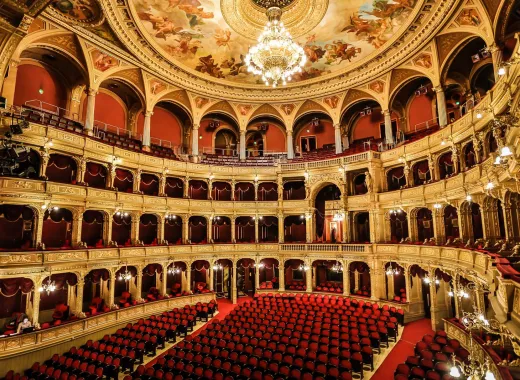



 RM Europa Ticket GmbH
  Call now
 Book now