
 EN
EN DE
DE IT
IT FR
FR ES
ES RU
RU JP
JP RO
RO
Mefistofele
Order tickets
May 2027  | ||||||
|---|---|---|---|---|---|---|
Mo | Tu | We | Th | Fr | Sa | Su |
Mefistofele – Arrigo Boito | Opera
Running time: 3 hours 45 minutes including two intervals
Language: Italian
Surtitle: Hungarian, English, Italian
Arrigo Boito is one of the most unique figures in the history of music, not least of all because of his work as a poet: he is responsible for some of the finest librettos ever written for opera (including, for example, Otello). Smitten with Wagner and metaphysics, it's no surprise that he became enamoured with Goethe's Faust, in particularly with the figure of the devil. Mefistofele is his sole completed opera for which he also composed the music. Balázs Kovalik's thrilling production focuses on the mystery of the eternal duel between God against Satan, using powerful imagery to amplify Boito's own personalised poetic treatment of the subject. "The greatest mystery of all isn't the fact that one is thrust into the infinity of creation and the cosmos, but rather that in one in captivity there, we become aware of thoughts powerful enough to make us doubt that our lives are not simply fleeting moments of nothingness after all." (Béla Hamvas)
Parental guidance: The performance is not recommended for children under 16 years of age.
Synopsis
Prologue
In timeless eternity, cherubim praise the Lord of The Heavens.
The Spirit of Negation incited rebellion in heaven and was doomed to fail.
Mefistofele criticises the Creator contemptuously and his pampered creation, the self-conceited speck of dust, who regards his own bumptious illusion as reason, and calls himself a human. His unquenchable quest for knowledge, behold, makes Faust miserable and desirous; no science can restrain his feverish dreams, and now he wishes to become superhuman. Mefistofele offers to make a wager with the Lord, in which Faust's soul is at stake. The Forces of Good accept the challenge. Mefistofele listens nauseously to the golden-locked angels' sugary humming and leaves heaven with disgust.
The resounding hymn of the Heavenly Hosts permeates the world.
The greatest of mysteries is not that coincidence threw man somewhere in the middle of the material and the cosmos of stars, but the fact that in this confinement we have aroused ideas in our minds which are grand enough to question that our life is nothing.
Act 1
Tired of his philosophical studies, Faust is watching the colourful bustle of burghers carousing in the marketplace of Frankfurt. Eventually, enthusiasm flares within him: he leaves his bleak cell, and dives into the cheerful throng. But dusk descends, the city stills, and the master and his pupil find themselves alone in the suddenly desolate streets. Only a dark-clad figure follows who interrupts Faust's dreaming of the beauty of spring, and reveals his identity. He calls himself the Spirit of Negation, the creative demolition. He offers worldly bliss to the doctor on the earth if he can be his soul's master - in the other world…
The great libraries of the modern age hold results of invaluable intellectual efforts in millions of volumes. And nothing is more certain than the fact that among the millions of tomes of these works there is none which has a genuine role in the life of mankind. The whole modern culture of humanities, psychology, literature and social sciences, philosophy, moral, aesthetics, philology and theology are entirely and without exception unimplemented, and even unable to be applied, they can never be realised because reality cannot be learnt from these works.
Faust is attracted by beauty borne of simplicity: he is courting Margareta, whose life, burdened with mundane household chores is turned upside down by the cavalier's arrival. While Mefistofele is struggling with her neighbour Martha, the girl is enchanted by the doctor's pseudo-philosophical seduction; he accepts the sleeping draught for her mother so that she can spend a night of passion with Faust.
Act 2
Mefistofele takes Faust to the orgy of a Witches' Sabbath, where the doctor is fascinated by the vibrating light of the incubi. The damned happily greet their king, and listen with delight to his cynical prophecy about the destruction of the world. The wheels are turning, the bones are rattling, and the diabolical dance becomes ever more impetuous when Faust sees a vision of Margareta languishing in prison. His pangs of guilt are drowned out by the euphoric revelries.
People of the modern age, each and every one of them, and especially the so-called culture-makers: moralists, teachers, scholars, priests and statesmen are all convinced that they live an exceptionally exquisite life. Out of their agreeable and highbrow thoughts nothing is implemented neither generally nor personally, it is entirely intellectual illusion which often conceals the life of on ordinary, arrogant, boasting, conceited, shallow, insolent, wicked, and in all cases primitive person.
Margareta is sentenced to death for murdering her child and poisoning her mother. Faust arrives at the death cell to rescue her on her last night, shocked by the sight of a lover who had been driven to insanity. Mefistofele's appearance destroys the forlorn hope of happiness in the distant future: Margareta recognises the Tempter in him with horror. She turns away from her former lover with disgust, and refuses the freedom which he offers to her. She is condemned.
Act 3
We are in utopian Greece, which has vanished in the mists of centuries and is perhaps just the figment of poets' imagination. Mefistofele takes Faust to Helen of Troy to make him forget Margareta. The queen suffers from visions of the war fought for her and bloodshed she caused, but Faust's confession of love is like a balm to her. The sensuous rite of the classic Witches' Sabbath satisfies their passion and raises them above reality.
Life has become pointless, and this pointlessness has permeated all aspects of life and filled every momentum of life. If life is pointless, then the sole objective of a man's life is idle pleasure; the delight of the irresponsible Self.
The deal is not completed yet. Although Faust has enjoyed all the worldly bliss and his last hour on earth is approaching, he has not found the moment when he would have stopped time. Still, at the moment of death he must face his fate; his soul is now carried away by a utopian vision in which he finds the meaning of his whole life.
The modern man lives in the false belief that he himself has to create the spirit of intensive cultivation, set the objectives, create the standards and work out the ideals. The spirit of love in man has known what is to be done since the beginning of time. Forces should not be used to create a new spirit but implement the eternal and universal spirit.
Program and cast
Conductor: János Kovács
Bass: Gábor Bretz
Tenor: Gaston Rivero
Soprano: Orsolya Sáfár
Soprano: Orsolya Sáfár
Tenor: Barna Bartos
Tenor: Barna Bartos
Mezzo-soprano: N. N.
Mezzo-soprano: N. N.
Featuring the Hungarian State Opera Orchestra and Chorus
Director: Balázs Kovalik
Set designer: Csaba Antal
Costume designer: Mari Benedek
Choreographer: Marianna Venekei
Ballet master: Ágnes Sárközy-Holler
Hungarian translation by Lajos Csákovics
English translation by Arthur Roger Crane
Head of the Children's Chorus: Nikolett Hajzer
Chorus director: Gábor Csiki
Composer: Arrigo Boito
Librettist: Arrigo Boito
Hungarian State Opera
STANDING ROOM TICKETS - INFORMATION IN CASE OF A FULL HOUSE!
If all the seats are sold out for the selected time, but you still want to see the production on that day, 84 of the extremely affordable standing seats will be sold at the theatre, 2 hours before the start of the performance, with which you can visit the gallery on the 3rd floor. Tickets can be purchased at the ticket office of the Budapest Opera House. We would like to draw your attention to the fact that the stage can only be seen to a limited extent from the standing places and the side seats, but at the same time, following the performance is also supported by television broadcasting on the spot.
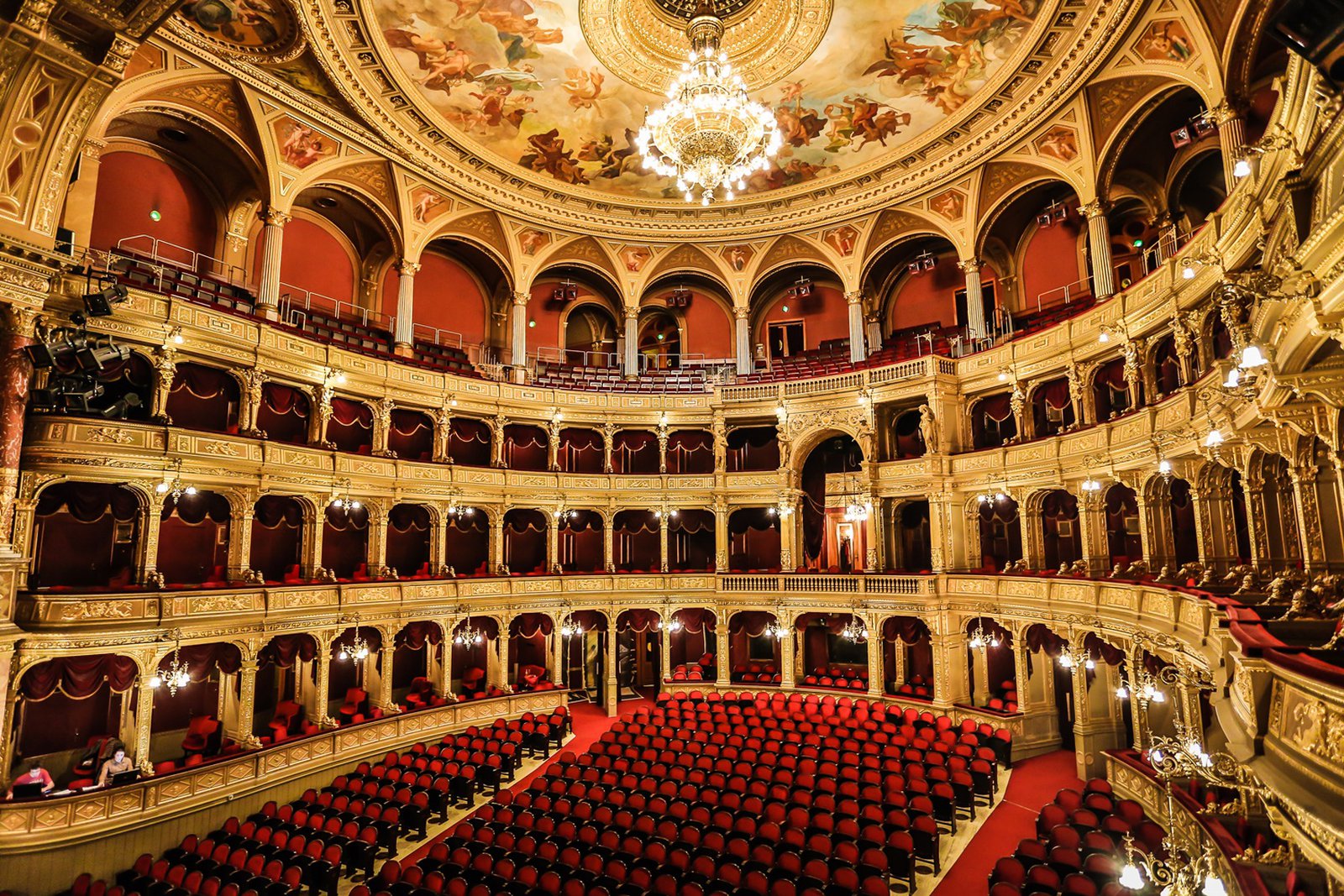
The Opera House is not only one of the most significant art relic of Budapest, but the symbol of the Hungarian operatic tradition of more than three hundred years as well. The long-awaited moment in Hungarian opera life arrived on September 27, 1884, when, in the presence of Franz Joseph I. the Opera House was opened amid great pomp and ceremony. The event, however, erupted into a small scandal - the curious crowd broke into the entrance hall and overran the security guards in order to catch a glimpse of the splendid Palace on Sugar út. Designed by Mikós Ybl, a major figure of 19th century Hungarian architecture, the construction lived up to the highest expectations. Ornamentation included paintings and sculptures by leading figures of Hungarian art of the time: Károly Lotz, Bertalan Székely, Mór Than and Alajos Stróbl. The great bronze chandelier from Mainz and the stage machinery moda by the Asphaleia company of Vienna were both considered as cutting-edge technology at that time.
Many important artists were guests here including Gustav Mahler, the composer who was director in Budapest from 1887 to 1891. He founded the international prestige of the institution, performing Wagner operas as well as Magcagni’ Cavalleria Rusticana. The Hungarian State Opera has always maintained high professional standards, inviting international stars like Renée Fleming, Cecilia Bartoli, Monserrat Caballé, Placido Domingo, Luciano Pavarotti, José Cura, Thomas Hampson and Juan Diego Flórez to perform on its stage. The Hungarian cast include outstanding and renowed artists like Éva Marton, Ilona Tokody, Andrea Rost, Dénes Gulyás, Attila Fekete and Gábor Bretz.
©

Related events