


Leander and Linseed

Order tickets
January 2027 Next
Mo
Tu
We
Th
Fr
Sa
Su


Leander and Linseed – Zsófia Tallér / Andor Szilágyi / Barnabás Szöllősi

Fairy Tale Opera

Running time: 1 hour 50 minutes including one interval

Language: Hungarian

Surtitle: Hungarian, English


The tale of Leander the goblin and Princess Linseed, brimming with magic and a seemingly unbreakable curse, not to mention a wealth of twists and turns, is a genuinely good yarn. Set to a libretto by Barnabás Szöllősi that is based on Andor Szilágyi's fable for the theatre and written at the OPERA's request in the 2014/15 season, Erkel Prize-winning composer Zsófia Tallér's masterful, expressive and entertaining music makes this Hungarian fairy tale opera an enjoyable experience for children and adults alike, and, we hope, a possible future classic.


Parental guidance: The performance is not recommended for children under 8 years of age.


Synopsis


Act I

The melancholy goblin Leander has been holding King Baldemar the Second as his prisoner for the last 17 years and nine months as punishment for accidentally shooting his favourite cat and only friend, Czirbolya, with an arrow. Leander also has a servant, a forest gnome named Berry, who has had no other work for the last nearly two decades other than to torment his royal prisoner. But now he's getting bored of this behaviour and begs his master to set the king free. Leander, in exchange for his cat and the king's freedom, demands that King Baldemar give him something the king doesn't even know he possesses. The newly released monarch only understands what he's giving away after he has promised it and returns home to his palace to find he has a daughter, Princess Linseed, who is now celebrating her 17th birthday. Baldemar hasn't been away for one day, as he thought, but for exactly 17 years and nine months!

He locks his daughter in a cage and calls on her suitor, Prince Bitesting, to come to her defence. Leander comes for Linseed and immediately falls in love with the beautiful girl, who in turn finds herself enchanted with the goblin's marvellous voice and kind speech. Leander loses his courage and leaves the girl behind, but then is overcome with love and returns, only to face the cowardly Prince Bitesting's hornet brigade. He defeats the insect soldiers and sends the prince fleeing, but at the critical moment Linseed has her first glimpse of Leander and, repulsed by his ugliness, thrusts the rose he has given her as a gift into his face. Leander departs in shame.


Act II

Linseed and her servant Chickbeak are in the court of the Honeycoat Fairy for a lesson in etiquette. Linseed realises that she's in love with Leander, and the girls resolve to escape, because King Baldemar and his retinue are planning to hold the wedding there. Despite all of this, Prince Bitesting forgets that he is betrothed to Linseed and instead falls in love with Honeycoat Fairy. After the girls escape, the two new lovers also head off on the same path as the runaways. In the meantime, Leander has forgiven Linseed for the rose she threw in his face and heads out to Honeycoat Fairy's domain in order to rescue her. No one finds anyone. The two girls encounter Berry in the woods, and the gnome and Chickbeak also fall in love with each other. Berry only knows one way to rescue Leander: by enlisting the help of Blindleech. Linseed does so, but finding the right path will cost her her eyesight: the only way she can find Leander is by blindly following her heart. This sacrifice lifts Honeycoat's curse, and Leander reverts into a man, and a handsome one at that. By threatening Blindleech, he regains Linseed's eyesight for her, and Leander and Linseed, together with Berry and Chickbeak, head off to the royal couple to bless their nuptials. Honeycoat and Prince Bitesting join them at the palace, where a triple wedding ensues.


Program and cast

Conductor: Peter Dobszay

Leander: Attila Dobák

Linseed: Boglárka Brindás

Prince Bitesting: Botond Pál (opera studio)

Chickbeak: Anija Lombard (opera studio)

King Baldemar: László Szvétek

Queen Baldemar: Andrea Meláth

Honeycoat Fairy: Zita Váradi


Featuring the Hungarian State Opera Orchestra


Director: András Almási-Tóth

Costume designer: Richárd Márton


Composer: Zsófia Tallér

Librettist: Barnabás Szöllősi

Hungarian State Opera

STANDING ROOM TICKETS - INFORMATION IN CASE OF A FULL HOUSE!

If all the seats are sold out for the selected time, but you still want to see the production on that day, 84 of the extremely affordable standing seats will be sold at the theatre, 2 hours before the start of the performance, with which you can visit the gallery on the 3rd floor. Tickets can be purchased at the ticket office of the Budapest Opera House. We would like to draw your attention to the fact that the stage can only be seen to a limited extent from the standing places and the side seats, but at the same time, following the performance is also supported by television broadcasting on the spot.

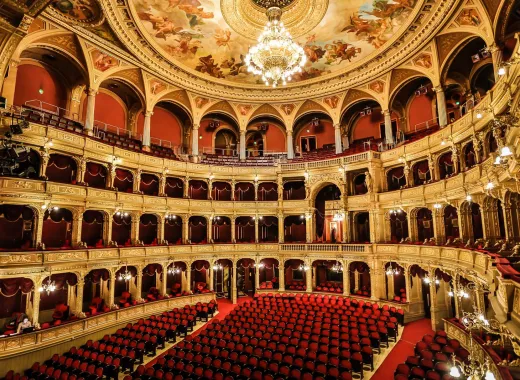
The Opera House is not only one of the most significant art relic of Budapest, but the symbol of the Hungarian operatic tradition of more than three hundred years as well. The long-awaited moment in Hungarian opera life arrived on September 27, 1884, when, in the presence of Franz Joseph I. the Opera House was opened amid great pomp and ceremony. The event, however, erupted into a small scandal - the curious crowd broke into the entrance hall and overran the security guards in order to catch a glimpse of the splendid Palace on Sugar út. Designed by Mikós Ybl, a major figure of 19th century Hungarian architecture, the construction lived up to the highest expectations. Ornamentation included paintings and sculptures by leading figures of Hungarian art of the time: Károly Lotz, Bertalan Székely, Mór Than and Alajos Stróbl. The great bronze chandelier from Mainz and the stage machinery moda by the Asphaleia company of Vienna were both considered as cutting-edge technology at that time.


Many important artists were guests here including Gustav Mahler, the composer who was director in Budapest from 1887 to 1891. He founded the international prestige of the institution, performing Wagner operas as well as Magcagni’ Cavalleria Rusticana. The Hungarian State Opera has always maintained high professional standards, inviting international stars like Renée Fleming, Cecilia Bartoli, Monserrat Caballé, Placido Domingo, Luciano Pavarotti, José Cura, Thomas Hampson and Juan Diego Flórez to perform on its stage. The Hungarian cast include outstanding and renowed artists like Éva Marton, Ilona Tokody, Andrea Rost, Dénes Gulyás, Attila Fekete and Gábor Bretz.


Opera de Stat Maghiară
Attila Nagy
©
Related events