

Laszlo Hunyadi

Order tickets
March 2027
Mo
Tu
We
Th
Fr
Sa
Su


László Hunyadi – Ferenc Erkel

Mix | Opera

Running time: 4 hours including two intervals

Language: Hungarian

Surtitle: Hungarian, English


János Hunyadi is responsible for the tolling of bells around the world; Mátyás Hunyadi is the hero of a string of folk tales; László Hunyadi inspired “only” an opera. An opera that is actually about his younger brother, the last great King of Hungary, or at least the events leading up to his rule. However, our current aim is not to raise László from the dead, who was the reason for and explanation to why Mátyás Hunyadi ended up on the throne. True that the original score, heard for the first time in almost ninety years, provides an excellent opportunity to play the part of the knight, executed while he was still young. The purpose of this production is to stage a piece authentic to the original and to use it to showcase the artistic and technical possibilities of the restored Opera House.


The production of this work was created based on the critical edition series Ferenc Erkel Operas from the Department of Hungarian Music History of the Institute for Musicology of the Research Centre for the Humanities.


Parental guidance - The performance is not recommended for children under 12 years of age.


Synopsis


Act I
The young László Hunyadi, the eldest son of the dead hero, János, is warned by his soldiers summoned to Nándorfehérvár in the presence of his younger brother, Mátyás that he is in deadly danger, but he receives the arriving King László V as a humble subject of his. However, the foreign mercenaries are not allowed in the castle, and that serves as a reason for the royal uncle, regent Ulrik Cillei, a bitter enemy of the Hunyadis, to get permission to kill him. But Hunyadi’s supporters are informed about his plan by Rozgonyi, whose role is not clear, and they kill the schemer. The startled king apparently forgives this deed.


Act II
The widowed Erzsébet Szilágyi is worried for her son László in Temesvár, seeing a vision of him being handed to the executioner. The king makes a solemn promise to fully forgive them, and makes the two Hunyadi sons his honorary brothers. At the same time, he takes a liking to László’s fiancée, the beautiful Mária Gara, and the girl’s father instantly recognizes the ignoble opportunity in this.


Act III
Gara convinces the king yearning for Mária to get rid of László Hunyadi. They arrest him at the engagement party of László and Mária, interrupting the celebration.


Act IV
Mária urges her prisoner lover to escape, but he trusts the king’s promise. Eventually, László Hunyadi is bound for the scaffold, and so Erzsébet Szilágyi has to watch as her nightmare vision comes true. The executioner strikes three times, still the innocent youth stays alive. Instead of mercy, the palatine gives the order to strike him yet again, finally beheading Hunyadi.

Program and cast

Conductor - Zsolt Hamar

King László V - Tibor Szappanos

Ulrik Cillei, the regent - András Kiss

Erzsébet Szilágyi - Klára Kolonits

László Hunyadi - Szabolcs Brickner

Mátyás Hunyadi (voice) - Laura Topolánszky

Mátyás Hunyadi (actor) - N. N.

Miklós Gara - Krisztián Cser

Mária Gara - Zita Szemere

Rozgonyi - Gergely Halász (opera studio)


Featuring the Hungarian State Opera Orchestra, Chorus, and Children’s Chorus, as well as the Hungarian National Ballet, and pupils of the Hungarian National Ballet Institute


Director - Dr. Szilveszter Ókovács

Text reworked by - Dr. Szilveszter Ókovács

Urtext score by Kim Szacsvai

Artistic advisor - András Almási-Tóth

Set and costume designer - Krisztina Lisztopád

Lighting designer - Tamás Pillinger

Video designer - Zsombor Czeglédi

Movement director - Dávid Molnár

Choreographer - Tamás Solymosi

Assistant choreographer - Marianna Venekei

English translation by Kinga Keszthelyi

Head of the Children's Chorus - Nikolett Hajzer

Chorus director - Gábor Csiki


Composer - Ferenc Erkel

Librettist - Béni Egressy

Hungarian State Opera

STANDING ROOM TICKETS - INFORMATION IN CASE OF A FULL HOUSE!

If all the seats are sold out for the selected time, but you still want to see the production on that day, 84 of the extremely affordable standing seats will be sold at the theatre, 2 hours before the start of the performance, with which you can visit the gallery on the 3rd floor. Tickets can be purchased at the ticket office of the Budapest Opera House. We would like to draw your attention to the fact that the stage can only be seen to a limited extent from the standing places and the side seats, but at the same time, following the performance is also supported by television broadcasting on the spot.

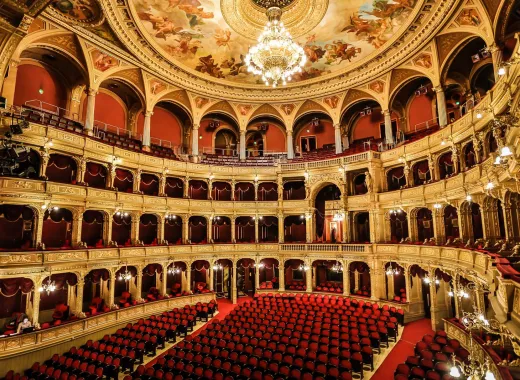
The Opera House is not only one of the most significant art relic of Budapest, but the symbol of the Hungarian operatic tradition of more than three hundred years as well. The long-awaited moment in Hungarian opera life arrived on September 27, 1884, when, in the presence of Franz Joseph I. the Opera House was opened amid great pomp and ceremony. The event, however, erupted into a small scandal - the curious crowd broke into the entrance hall and overran the security guards in order to catch a glimpse of the splendid Palace on Sugar út. Designed by Mikós Ybl, a major figure of 19th century Hungarian architecture, the construction lived up to the highest expectations. Ornamentation included paintings and sculptures by leading figures of Hungarian art of the time: Károly Lotz, Bertalan Székely, Mór Than and Alajos Stróbl. The great bronze chandelier from Mainz and the stage machinery moda by the Asphaleia company of Vienna were both considered as cutting-edge technology at that time.


Many important artists were guests here including Gustav Mahler, the composer who was director in Budapest from 1887 to 1891. He founded the international prestige of the institution, performing Wagner operas as well as Magcagni’ Cavalleria Rusticana. The Hungarian State Opera has always maintained high professional standards, inviting international stars like Renée Fleming, Cecilia Bartoli, Monserrat Caballé, Placido Domingo, Luciano Pavarotti, José Cura, Thomas Hampson and Juan Diego Flórez to perform on its stage. The Hungarian cast include outstanding and renowed artists like Éva Marton, Ilona Tokody, Andrea Rost, Dénes Gulyás, Attila Fekete and Gábor Bretz.


Opera de Stat Maghiară
Attila Nagy
©
Related events