
 EN
EN DE
DE IT
IT FR
FR ES
ES RU
RU JP
JP RO
RO
King Pomade´s New Clothes
Order tickets
April 2027  | ||||||
|---|---|---|---|---|---|---|
Mo | Tu | We | Th | Fr | Sa | Su |
King Pomade's New Cothes – György Ránki
Contemporary | Opera
Running time: 1 hour without intervals
Language: Hungarian
Surtitle: Hungarian, English
His Majesty King Pomade has a big problem: he doesn't have a single thing to wear for his name day celebration, because he's already worn every piece of clothing in his wardrobe. Sometimes more than once! But then two strange weavers arrive in the kingdom to promise the king garments woven from a miraculous cloth – and not just any kind of garments: only people who are honest and true will be able to see them! György Ránki's popular children's opera is at heart built around the world of Hungarian folk song, but also incorporates jazz and parodic styles. With sparkling musical humour, the composer holds a carnival mirror up to the hypocritical world of the royal court. (And please don't tell anyone, but the king is naked!)
Parental guidance - The performance is not recommended for children under 6 years of age.
Synopsis
The marketplace is buzzing with hustle and bustle. Dani and Béni loudly proclaim that the weaver's craft is the most useful of all trades, especially if somebody knows how to weave cloth as wondrous as theirs is. At this point, the patrolling guardsmen come over, and when the captain learns that the two strangers from far away are offering miraculous fabrics for sale, they immediately take them to the king. Because His Serene Highness King Pomade has a problem. The next day he will be celebrating his name day, the day each year when he marches in a glorious procession before his beloved people. This time, however, it looks like the eagerly awaited ceremony will have to be cancelled, because the king does not have a single item of clothing that he hasn't worn at least once before. Even though he has lots and lots of clothes, the king is bored with all of them, and the tailors have run out of ideas.
After the great monarch has polished off his ample breakfast, the two miracle weavers are brought before him. To great joy, the king rescinds his previous command to call of the next day's parade. Now he'll have something to wear after all, and won't have to spend his name day in bed! Dani and Béni promise to weave the wondrous fabric out of their miracle thread, and to sew him a wondrous suit out of it. However, they also mention one more thing: the clothing has an important feature. Only people who are intelligent, honest and just can see it. Those who lie or are wicked or stupid will see nothing but thin air.
The king is tormented by nightmares all night. What will happen if he can't see this miraculous clothing of theirs? He quickly sends out his chancellor and ministers to take a peek at the weavers' work. If they can see the cloth, then he certainly will too, since a king cannot be stupider than his subordinates, and “God gives brains to those he puts in office.” Meanwhile, Dani and Béni are industriously sewing away at nothing. Of course neither the chancellor nor the ministers see anything, but none of them dare admit it.
In the morning, the king himself shows up. At first he is too astonished to speak, but the weavers exalt their own work so highly that finally he is persuaded to march behind the folding screen and try it on. The clothing fits his fine figure so well, he almost feels that he isn't wearing any clothes at all.
At last, it's time for the great event. The procession marches through the marketplace, and out from the grand baldachin emerges the king, completely naked. In the frozen silence, a single voice belonging to a little apprentice shoemaker calls out shrilly: “the king isn't wearing any clothes!” Then all hell breaks loose. A storm of onions and tomatoes rain down on the king and his court. The grandees flee, racing off in all directions.
Program and cast
Conductor: Johannes Marsovszky
King Pomádé: Krisztián Cser
Dani: Artúr Szeleczki
Béni: Máté Fülep
Chancellor Tobias: Bence Pataki
Garda Roberto: Attila Erdős
Dzsufi: Eszter Zemlényi
Captain: N. N.
Corporal: N. N.
Featuring the Hungarian State Opera Orchestra and Chorus
Director: Attila Toronykőy
Set and costume designer: Katalin Juhász
Costume designer: Katalin Juhász
Choreographer: Gábor Horváth
English translation by Arthur Roger Crane
Chorus director: Gábor Csiki
Composer: György Ránki
Librettist: Amy Károlyi
Hungarian State Opera
STANDING ROOM TICKETS - INFORMATION IN CASE OF A FULL HOUSE!
If all the seats are sold out for the selected time, but you still want to see the production on that day, 84 of the extremely affordable standing seats will be sold at the theatre, 2 hours before the start of the performance, with which you can visit the gallery on the 3rd floor. Tickets can be purchased at the ticket office of the Budapest Opera House. We would like to draw your attention to the fact that the stage can only be seen to a limited extent from the standing places and the side seats, but at the same time, following the performance is also supported by television broadcasting on the spot.
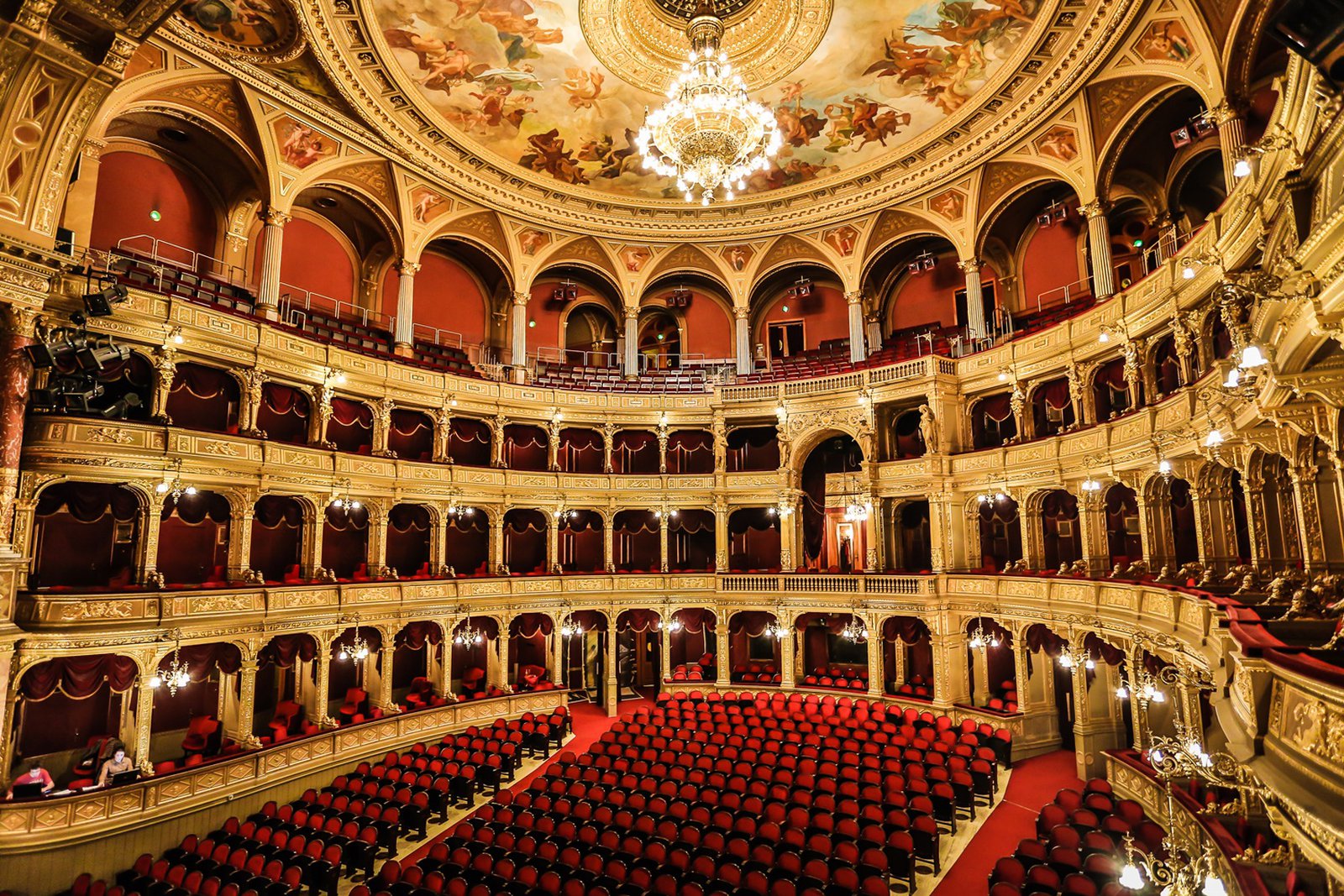
The Opera House is not only one of the most significant art relic of Budapest, but the symbol of the Hungarian operatic tradition of more than three hundred years as well. The long-awaited moment in Hungarian opera life arrived on September 27, 1884, when, in the presence of Franz Joseph I. the Opera House was opened amid great pomp and ceremony. The event, however, erupted into a small scandal - the curious crowd broke into the entrance hall and overran the security guards in order to catch a glimpse of the splendid Palace on Sugar út. Designed by Mikós Ybl, a major figure of 19th century Hungarian architecture, the construction lived up to the highest expectations. Ornamentation included paintings and sculptures by leading figures of Hungarian art of the time: Károly Lotz, Bertalan Székely, Mór Than and Alajos Stróbl. The great bronze chandelier from Mainz and the stage machinery moda by the Asphaleia company of Vienna were both considered as cutting-edge technology at that time.
Many important artists were guests here including Gustav Mahler, the composer who was director in Budapest from 1887 to 1891. He founded the international prestige of the institution, performing Wagner operas as well as Magcagni’ Cavalleria Rusticana. The Hungarian State Opera has always maintained high professional standards, inviting international stars like Renée Fleming, Cecilia Bartoli, Monserrat Caballé, Placido Domingo, Luciano Pavarotti, José Cura, Thomas Hampson and Juan Diego Flórez to perform on its stage. The Hungarian cast include outstanding and renowed artists like Éva Marton, Ilona Tokody, Andrea Rost, Dénes Gulyás, Attila Fekete and Gábor Bretz.
©

Related events