
 EN
EN DE
DE IT
IT FR
FR ES
ES RU
RU JP
JP RO
RO
© Shigeto Imura
Grzegorz Niemczuk, Legendary Piano Sonatas
Order tickets
December 2025 | ||||||
|---|---|---|---|---|---|---|
Mo | Tu | We | Th | Fr | Sa | Su |
LEGENDARY PIANO SONATAS
Frédéric Chopin in the company of two great classical composers - Mozart and Beethoven - and four piano sonatas is the latest offering from pianist Greg Niemczuk in the continuation of his classical music presentation project entitled. "Music and the Word".
It is extremely rare to hear two of Fryderyk Chopin's monumental piano sonatas during a piano recital. Greg Niemczuk rises to this daunting challenge and in addition presents two of the most famous sonatas in piano literature: Beethoven's "Moonlight" and Mozart's sonata with the famous "Turkish March". In addition, the pianist who will lead the concert will reveal the secrets of the construction of these masterpieces and will make listening to this challenging music much easier for people who come into contact with classical music less often.
This is how the artist himself describes the programme:
"Ludwig van Beethoven's Sonata in C sharp minor and Frédéric Chopin's Sonata in B minor have much in common - both were written during the most difficult periods of the composers' lives and are testimony to coping with the very painful experiences and emotions that each of us sometimes experiences. At the same time, they are examples of how to wring the strength to cope.
Mozart is a composer whose joyful and light music allows us to forget the heavy emotions of the first movement of the concerto, and Frédéric Chopin's Sonata in B minor is undoubtedly his greatest masterpiece, full of beautiful, unforgettable melodies. Its third movement is perhaps the most spiritual and "heavenly" work of piano music."
GRZEGORZ (GREG) NIEMCZUK
"His playing is characterised by fluency, a very wide dynamic range, from loud forte to whispery pianissimo, a variety of colours and timbres and dazzling virtuosity."
The Epoch Times, New York, 2013
Hailed by influential Japanese critics as "the modern incarnation of Chopin," Greg Niemczuk has established an international reputation as an outstanding connoisseur and interpreter of the music of Fryderyk Chopin, to whose study he has devoted many years of his artistic life. In January 2017, Polish Radio's First Programme ranked Greg Niemczuk's interpretation of Chopin alongside such distinguished artists as Martha Argerich, Maurizio Pollini and Adam Harasiewicz.
His prolific international solo career, now in its seventeenth year, has taken him to many prestigious concert halls around the world, including Carnegie Hall, Steinway Hall in New York, Kioi Hall, Tokyo Bunka Kaikan in Tokyo, Beijing Concert Hall in Beijing, Konzerthaus in Vienna, Rudolfinum in Prague, Tonhalle in Zurich, Stadtcasino in Basel, and many others.
To date, the pianist has given nearly 500 recitals and concerts, during which he has visited 36 countries on six continents (Poland, Czech Republic, Slovakia, Germany, Lithuania, Russia, Romania, Austria, Croatia, Serbia, Bulgaria, Switzerland, Italy, Belgium, Netherlands, France, Spain, Great Britain, Finland, Norway, Ethiopia, Tanzania, Japan, China, South Korea, Singapore, Malaysia, Australia, Peru, Brazil, Ecuador, Costa Rica, Colombia, United States, Jamaica, Curacao). He often conducts concerts himself, where he introduces the audience to the secrets of the music he performs and gives interesting facts from the biographies of composers. Wherever he performs, he is warmly received by audiences and critics alike, resulting in further invitations in the future. In 2025, he will perform in most of the Polish Philharmonics, the Vienna Konzerthaus, the Rudolfinum in Prague, the Tonhalle in Zurich, the Stadtcasin in Basel, the Bunka Kaikan in Tokyo, as well as making his debuts at the Gewandhaus in Leipzig and the Liederhalle in Stuttgart.
Program and cast
Duration of the programme 2 hours
Greg Niemczuk piano
Programme
Ludvig van Beethoven
Sonáta cis moll, op. 27 č. 2 „Měsíční svit“ ("Moonlight")
F. Chopin
Sonáta b moll, op. 35 (s „Pohřebním pochodem“) ("Funeral March Sonata")
- Intermission -
W. A. Mozart
Sonáta A dur KV 330 (s „Tureckým pochodem“) ("Turkish March Sonata")
F. Chopin
Sonáta h moll, op. 58
Rudolfinum
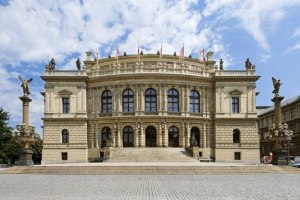
The Rudolfinum, one of the most noteworthy buildings in Prague, was built between 1876 and 1884 according to the designs of architects Josef Zítek and Josef Schulze. Originally intended as a multipurpose cultural building in Prague, the Rudolfinum was inagurated on February 7, 1885. It carried out its mission until 1919, when it was converted to the House of Commons of the Czechoslovak Republic. Concert activity was restored to the Rudolfinum during the German occupation, but full rehabilitation, particularly of the gallery, did not take place until 1992. After a general reconstruction by architect Karel Prager in 1992, the Rudolfinum became the home of the Czech Philharmonic and the Rudolfinum Gallery.
Dvorana – Ceremony Hall
The central space in the gallery portion of the Rudolfinum was designed by Josef Zítek and Josef Schulz as an entrance hall to the art gallery. After 1918, however, this space was converted into a parliamentary cafeteria, and after World War II it served as a gymnasium for the Prague Conservatory. At the end of the 1980s, Ceremony Hall was threatened with reconstruction – but plans to tear down the main staircase to make room for another concert hall did not go through, and the hall retained its original appearance. Of particular interest in Ceremony Hall are 25 empty spaces on its walls, which were originally intended to be filled in with frescos. The majority of the eminent Czech painters, however, boycotted the 1891 fresco competition in protest over the large number of German artists involved in the construction of the Rudolfinum.
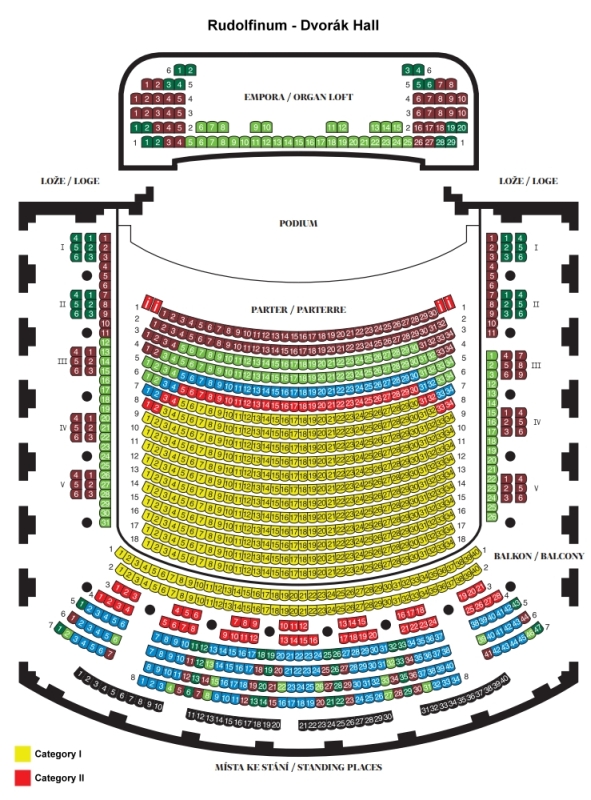
Dvořák Hall
The Czech Philharmonic took the stage in this world-famous concert hall in 1896, performing for its first-ever concert under the baton of Antonín Dvořák himself. The hall remained a space for concerts and performances until 1918, at which time it became a boardroom for the new parliament of the Czechoslovak Republic. The stage and the organ loft became a tribunal (garnished with a statue of President T.G. Masaryk), from which parliamentary leaders presided over proceedings. The hall's original character (and purpose) was restored
in 1940–1942 according to a project conceived by Antonín Engel and Bohumír Kozák, and it has remained in this form through to the present. In accordance with Josef Zítek and Josef Schulz's original proposal, the central visual element in the hall is an organ, which was made in Frankfurt, Germany. During the hall's stint as a parliamentary meeting place, the organ was housed in Brno. When it returned to the Rudolfinum in 1940, its register was extended. Dvořák Hall's final update took place in 1992 when the entire Rudolfinum building underwent reconstruction.
When travelling by public transport, get off at the Staroměstská metro station (Line A), tram stop (trams nos. 17, 18 and 53) or bus stop (no. 207).
Parking is available at the underground parking facility on Jan Palach Square. The facility is not part of the Rudolfinum premises.
Related events