


Dancingly Yours
September 2026 | ||||||
|---|---|---|---|---|---|---|
Mo | Tu | We | Th | Fr | Sa | Su |
Dancingly Yours – Sad Case, Trois Gnossiennes, Whirling, Études
Sol Leon – Paul Lightfoot – Hans van Manen – András Lukács – Harald Lander
Mix | Neoclassical ballet
Running time: 2 hours 30 minutes including two intermissions
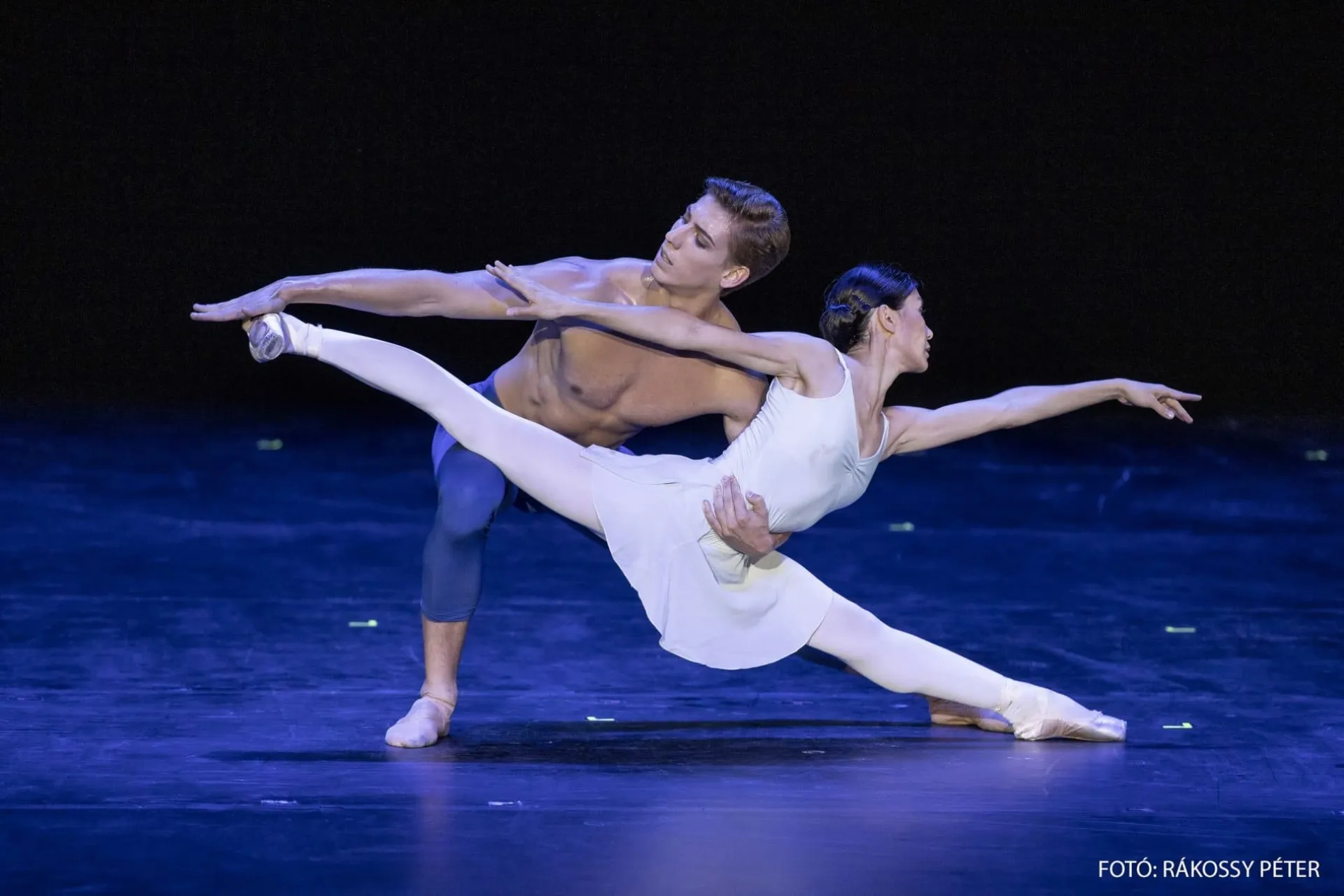
At its programme entitled Dancingly Yours, the ballet company of the Hungarian State Opera presents a selection of the most popular contemporary one-act works. The works by outstanding creators of the dance world, demanding breathtaking technique, portray the relationship and interdependence of men and women, offer a glimpse into an exciting yet unknown future, and depict finding your path on stage, where ballet itself also becomes a protagonist. With the combination of classical and contemporary, intimate and spectacular, melancholic and uplifting, the Hungarian National Ballet remains “Dancingly Yours”.
Parental guidance - The performance is not recommended for children under 12 years of age.
Sol León & Paul Lightfoot / P. Prado – A. Dominguez – E. Lecuona – R. Barretto – Trio Los Pancho
Sad Case
“Now in hindsight we realise that energy is everything. When we created Sad Case in 1998, so far in to Sol’s pregnancy, the hormones were jumping and emotions were high. It is these hormones of laughter, madness and the trepidation of the unknown ahead that are the umbilical chord of this work,” says the British Paul Lightfoot, thinking back to the origin of the ballet. He and his partner, the Spanish Sol León share credit for the performance’s choreography and set and costume designs. Up until 2020, León worked as artistic consultant and Lightfoot as artistic director for the Nederlands Dans Theater (NDT), where they were responsible for bringing about sixty creations, including Sad Case, which is undoubtedly one of the pillars of their work. In it, surprising movements set to Mexican mambo music reflect the ongoing search for the tension between the satirical and the serious. The OPERA had long planned the staging of this irresistible modern piece for Hungarian audiences – and by way of it, the art of the world-famous Lightfoot.
Hans van Manen / Erik Satie
Trois Gnossiennes
Built around the magically beautiful music of Erik Satie, Hans van Manen’s Trois Gnossiennes draws a picture of a unique relationship. This double portrait painted with sensitive brushstrokes flashes with images of trust, submission and dominance, and relativity and interdependence. Masterfully alternating between lyrical and grotesque elements and weaving together memorable human traits, van Manen depicts monologues and dialogue, as well as symbolic moments of a relationship rich in intimate profundities. The bravura elevation of simple poses to the level of acrobatics and the enigmatic and fantastic play with a living body that goes limp make this short but dense work an unforgettable one.
András Lukács / Philip Glass
Whirling
Whirling, a pas de deux by András Lukács, a former soloist with the Hungarian National Ballet is set to the second movement of Tirol Concerto by Philip Glass's, one of the greatest masters of repetitive music. The nearly fluid movement, the infinite harmony among the dancers and the unique style of choreography make the scene both quite exhausting and complicated. In 2010, the Hungarian National Ballet commissioned Lukács to create an expanded version for nine pairs. Tastefully and thrillingly combining elements based on classical techniques with modern devices, Lukács primarily creates plotless choreographies that are highly expressive. In Whirling, along with the music, the spiralling movements of the dancing superbly illustrate a vortex of water: the water into which the suicidal Virginia Woolf casts herself to music once again by Philip Glass in the film The Hours.
Harald Lander / Carl Czerny – Knudåge Riisager
Études
Études is a one-act ballet which poses a great challenge to ballet companies because its subject is the technique of classical ballet itself: the school, the everyday training and the assessment of understanding and skill. Perhaps this is why the famous American dance critic Arlene Croce dubbed this work an “anti-ballet”. Because, in a ballet, the perfection of skill in dance is traditionally presented to the audience through the content, and the arduous everyday practise usually remains hidden from the viewers. The dancer’s everyday work takes place in the ballet studio, where the “vocabulary” of dance is formulated inside each dancer’s body, which will later become the base for the performance of choreographies on the stage. The audience sees only the outcome. Danish choreographer Harald Lander, however, decided to initiate the viewer by presenting on the stage how a ballet exercise is constructed, and how the pure beauty of classical movements and steps triumph over even the laws of physics. Since the rediscovery of Études in Budapest, it has represented a tremendous opportunity for the company’s soloists and provided enjoyable, spectacular entertainment for the audience.
Program and cast
Sol León & Paul Lightfoot / P. Prado – A. Dominguez – E. Lecuona – R. Barretto – Trio Los Pancho
Sad Case
Girls: Maria Beck, Erina Yoshie, Aglaja Sawatzki, Yuki Wakabayashi
Boys: Gergő Ármin Balázsi, Taravillo Mahillo Carlos, Motomi Kiyota, Valerio Palumbo, Francesco Sardella, Riku Yamamoto
Featuring the Hungarian National Ballet.
Koreográfus / Choreographer: Sol León, Paul Lightfoot
Set designer: Sol León, Paul Lightfoot
Lighting designer: Tom Breevort
Répétiteur master: Lou Menghan
Company répétiteur: Cristina Balaban, James Forbat
Composer: Perez Prado, Alberto Dominguez, Ernesto Lecuona, Ray Barretto, Trio Los Panchos
Hans van Manen / Erik Satie
Trois Gnossiennes
Solo girl: Maria Yakovleva, Lili Felméry, Soobin Lee
Solo boy: Vlagyiszlav Melnyik, Mikalai Radziush, Boris Zhurilov
Featuring on Piano: Nataliya Pinelis, György Lázár
Featuring the Hungarian National Ballet.
Choreographer: Hans van Manen
Set designer: Hans van Manen
Costume designer: Joop Stokvis, Hans van Manen
Lighting designer: Jan Hofstra
Répétiteur: Igone de Jongh, Mária Aradi, Tamás Solymosi
Company répétiteur: Mária Aradi, Tamás Solymosi
Composer: Erik Satie
András Lukács / Philip Glass
Whirling
Conductor: Johannes Marsovszky, Paul Marsovszky
Solo girl: Jessica Leon Carulla, Lea Földi, Tatyjana Melnyik
Solo boy: Iurii Kekalo, Louis Scrivener, Luca Massara
Ballet soloist: Yevhenii Fomin, György Lázár
Featuring the Hungarian National Ballet and the Hungarian State Opera Orchestra.
Choreographer: András Lukács
Costume designer: Mónika Herwerth, Zsóka Szomolányi
Lighting designer: András Lukács
Company répétiteur: Marianna Venekei, István Kohári
Composer: Philip Glass
Harald Lander / Carl Czerny – Knudåge Riisager
Études
Conductor: Johannes Marsovszky, Paul Marsovszky
ETUDES Balerina: Tatyjana Melnyik, Maria Beck, Erina Yoshie
ETUDES Male soloists: Motomi Kiyota, Yago Guerra, Gergő Ármin Balázsi, Boris Zhurilov, András Rónai, Vince Topolánszky
Featuring the Hungarian National Ballet and the Hungarian State Opera Orchestra.
Choreographer: Harald Lander
Artistic advisor: Lise Lander
Staging ballet master: Johnny Eliasen
Company répétiteur: Ildikó Pongor, Stanislav Beliaevskii, Anastasia Dunets, James Forbat
Composer: Carl Czerny, Knudåge Riisager
Hungarian State Opera
STANDING ROOM TICKETS - INFORMATION IN CASE OF A FULL HOUSE!
If all the seats are sold out for the selected time, but you still want to see the production on that day, 84 of the extremely affordable standing seats will be sold at the theatre, 2 hours before the start of the performance, with which you can visit the gallery on the 3rd floor. Tickets can be purchased at the ticket office of the Budapest Opera House. We would like to draw your attention to the fact that the stage can only be seen to a limited extent from the standing places and the side seats, but at the same time, following the performance is also supported by television broadcasting on the spot.
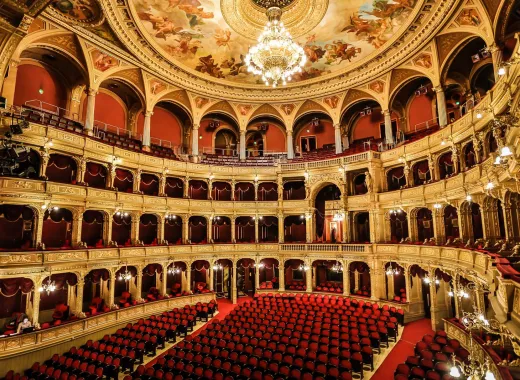
The Opera House is not only one of the most significant art relic of Budapest, but the symbol of the Hungarian operatic tradition of more than three hundred years as well. The long-awaited moment in Hungarian opera life arrived on September 27, 1884, when, in the presence of Franz Joseph I. the Opera House was opened amid great pomp and ceremony. The event, however, erupted into a small scandal - the curious crowd broke into the entrance hall and overran the security guards in order to catch a glimpse of the splendid Palace on Sugar út. Designed by Mikós Ybl, a major figure of 19th century Hungarian architecture, the construction lived up to the highest expectations. Ornamentation included paintings and sculptures by leading figures of Hungarian art of the time: Károly Lotz, Bertalan Székely, Mór Than and Alajos Stróbl. The great bronze chandelier from Mainz and the stage machinery moda by the Asphaleia company of Vienna were both considered as cutting-edge technology at that time.
Many important artists were guests here including Gustav Mahler, the composer who was director in Budapest from 1887 to 1891. He founded the international prestige of the institution, performing Wagner operas as well as Magcagni’ Cavalleria Rusticana. The Hungarian State Opera has always maintained high professional standards, inviting international stars like Renée Fleming, Cecilia Bartoli, Monserrat Caballé, Placido Domingo, Luciano Pavarotti, José Cura, Thomas Hampson and Juan Diego Flórez to perform on its stage. The Hungarian cast include outstanding and renowed artists like Éva Marton, Ilona Tokody, Andrea Rost, Dénes Gulyás, Attila Fekete and Gábor Bretz.


EN
DE
IT
FR
ES
RU
JP
RO
Seating plan